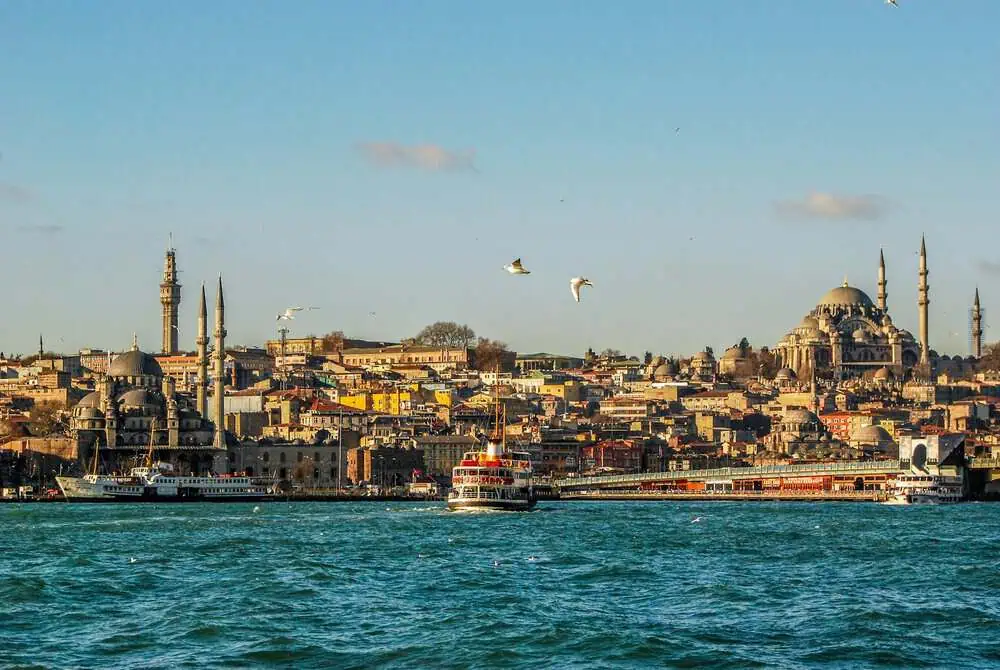
Istanbul doesn’t really work as a city unless you get on the water at some point. Every skyline photo, every “best view in Istanbul” list, every local’s answer to “what should I not miss” comes back to the same thing: the Bosphorus and the Golden Horn. One is the strait that splits Europe from Asia. The other is the inlet that splits the old city from itself. Together they’re the reason Istanbul looks the way it does — and the cheapest, most reliable way to actually understand that is a 45-minute ferry ride that costs less than a bottle of water at your hotel.
This guide is built to answer the practical question first: which boat, which route, which price, and where the tourist traps are. Then it goes deeper into the parts most guides skip — how the ferry system actually works day to day, which neighborhoods are worth stepping off for, and what the water itself is like to be on.
Bosphorus or Golden Horn — What’s the Difference?
It’s a fair question, and a lot of first-time visitors mix the two up.
- The Bosphorus is the 30-kilometer strait connecting the Black Sea to the Sea of Marmara. It’s the actual continental divide — Europe on one bank, Asia on the other. This is where you’ll find the big waterfront palaces, the fortress ruins, the two suspension bridges, and the wooden Ottoman mansions (yalı) that line the shore.
- The Golden Horn (Haliç) is a narrower, calmer inlet that branches off the Bosphorus near Galata Bridge and curves inland for about 7.5 kilometers. It’s not a strait between continents — it’s entirely on the European side. Historically it was Istanbul’s harbor and shipyard; today it’s where you’ll find the colorful, low-key neighborhoods of Fener, Balat, and Eyüp.
Think of the Bosphorus as the grand, cinematic waterway and the Golden Horn as its quieter, more intimate cousin. Most visitors do the Bosphorus first because it’s the postcard. Fewer make it to the Golden Horn, which is exactly why it feels more like a local’s route once you do.
{Map graphic showing the Bosphorus strait and Golden Horn inlet relative to Istanbul’s historic peninsula}
The Ferry System: Your Main Tool, Not Just a Tourist Activity
Here’s the thing that most visitor guides underplay: the ferries aren’t a novelty attraction bolted onto the city for tourists. They’re daily public transport. Commuters ride them to work in suits with coffee in hand. Kids do homework on them. Someone is always feeding the seagulls off the back deck, and someone else is always yelling at them to stop, because the gulls have learned to dive-bomb sesame simit right out of people’s hands.
That matters practically: it means the boats run often, they run on genuine schedules (not “whenever it fills up”), and they’re absurdly cheap compared to a dedicated tourist cruise. It also means they get crowded at rush hour, and you shouldn’t expect a hushed, curated sightseeing experience on a commuter run — you’ll be standing next to someone’s grocery bags.
The company behind almost everything you’ll ride is Şehir Hatları (“City Lines”), which has been running Istanbul’s ferries since 1851 and is now operated by the city’s metropolitan municipality. It’s not the only operator — private companies like Turyol and Dentur Avrasya run their own boats on overlapping routes — but Şehir Hatları is the backbone, and their piers are the ones you’ll use most.
How to Pay: İstanbulkart, Explained Honestly
You need an İstanbulkart — Istanbul’s rechargeable transit card — for public ferries, and honestly for the metro, tram, and bus too. Skip the confusion of contactless bank card payments; while some turnstiles accept them, they charge full fare every single time with zero transfer discount, which adds up fast if you’re island-hopping or connecting between the ferry and the tram.
A few things worth knowing before you’re standing at a turnstile with a boat about to leave:
- The blank anonymous card itself costs around 165 TL, non-refundable, and doesn’t include any travel credit — you load that separately.
- A standard ferry ride runs somewhere in the 45–60 TL range depending on the route’s distance, though fares are adjusted periodically, so treat any number you read (including this one) as directional rather than gospel. Check the Şehir Hatları or İETT app before you travel for the live figure.
- One card works for a whole group — you can tap it multiple times for multiple people, so you don’t need to buy a card per person.
- The transfer discount (cheaper second and third rides within a couple of hours) is mostly reserved for personalized, registered İstanbulkarts, which require a Turkish ID or a registration process that isn’t worth the hassle for a short trip. As a visitor with an anonymous card, budget for full fare on every leg.
- Buy and top up at the yellow Biletmatik machines found at metro stations, tram stops, and most major ferry piers, including the airport. Cash in small notes works best — the machines can be fussy about worn or large bills.
Common mistake: tourists often try to buy single paper tickets at ferry piers, assuming it’ll be simpler than the card. It’s almost always more expensive and slower. Get the card on day one; it pays for itself within two or three rides.
The Bosphorus Commuter Routes (Cheap, Fast, Real Istanbul)
If you want the Bosphorus experience without paying for a dedicated cruise, ride a regular intercontinental commuter ferry. These cross between the European and Asian sides constantly, and they hit some of the same visual highlights as a paid tour — just without commentary and without the extra hours.
Key routes to know:
- Eminönü ↔ Üsküdar and Eminönü ↔ Kadıköy — classic crossings from the historic peninsula.
- Beşiktaş ↔ Kadıköy and Beşiktaş ↔ Üsküdar — quick, frequent hops if you’re staying near Beşiktaş or Nişantaşı.
- Karaköy ↔ Kadıköy — handy if you’re based around Galata.
- Kabataş ↔ Kadıköy — useful if you’re near Taksim, since Kabataş connects to the funicular up to Taksim Square.
These run roughly every 15–20 minutes during peak commuting hours (around 7:00–9:30 AM and 5:00–7:30 PM) and every 20–30 minutes outside those windows, generally from early morning until close to midnight, though exact frequency shifts by route and season. The crossing itself typically takes 20–40 minutes depending on which piers you’re connecting.
The real insider move: hop on any Kadıköy- or Üsküdar-bound commuter ferry from Eminönü or Beşiktaş around sunset. You get open water, the Maiden’s Tower silhouette, the mosques of the historic peninsula lighting up, all for the same fare as crossing to buy groceries. No tour company can undersell that.
{Photo of commuters and tourists mixed together on an open ferry deck, Bosphorus in the background}
Bosphorus Sightseeing Cruises: Which One to Actually Book
If you want a proper, dedicated sightseeing cruise rather than a commuter hop, you’ve got three real tiers to choose from. Here’s how they actually compare, not just in price but in what the experience feels like.
1. The Şehir Hatları Public Cruises (Best Value)
This is the official municipal option and, for most travelers, the smartest choice. Two versions exist:
Short Circle Cruise (Kısa Boğaz Turu)
- Around 2 hours, loops up to roughly the second bridge and back without disembarking anywhere.
- Runs seasonally — typically only in summer months (mid-June through mid-September). Outside that window, it usually isn’t running at all, which trips up a lot of people who plan a short cruise for a spring or winter trip.
- Good for a quick overview if you’re short on time or don’t want a full day committed to the water.
Full Bosphorus Cruise (Uzun Boğaz Turu)
- Runs year-round, departing Eminönü around 10:35 AM (some seasons add a second afternoon departure).
- Takes about 6 hours round trip, sailing all the way to Anadolu Kavağı, a small fishing village near the Black Sea entrance, with a stop of roughly 2.5–3 hours there before heading back.
- This is genuinely the best way to see the entire strait — both fortresses (Rumeli Hisarı and Anadolu Hisarı), both bridges, the wooden yalıs, the palaces, and open water near the Black Sea that most visitors never see.
During the Anadolu Kavağı stop, you’re free to wander: climb up to the ruined Yoros Castle for a panoramic view where the strait meets the Black Sea, or just sit down at one of the small seafood restaurants lining the harbor. Fair warning — the food there isn’t included in your ticket and isn’t the city’s best value; you’re partly paying for the view. It’s still a nice, unhurried break rather than a rushed photo stop.
Pros: cheapest option by a wide margin, covers the full strait, genuinely scenic, boards multiple points (Eminönü, Beşiktaş, Üsküdar). Cons: fixed schedule with only one or two daily departures, no live commentary in some seasons, can get crowded on weekends, and it eats most of a day if you take the full version.
2. Private Operators (Turyol, Dentur Avrasya)
These run shorter loops — usually 90 minutes to under 2 hours — with more frequent departures throughout the day, often hourly starting around mid-morning. They’re a solid middle ground if the Şehir Hatları schedule doesn’t line up with your day, or if the Short Circle Cruise isn’t running in your travel season.
Pros: flexible timing, no need to plan your whole day around one departure, similar route coverage on the central stretch of the strait. Cons: somewhat pricier per hour than the public option, and you’ll cover less of the strait than the full-day cruise (no Anadolu Kavağı stop).
3. Dinner Cruises and Private Yachts (Splurge Territory)
Evening dinner cruises with live music, a fixed menu, and a table by the window are widely marketed around Sultanahmet and Taksim. They can be genuinely fun for a special occasion, but go in with realistic expectations: food quality is usually mid-tier at best, the “live entertainment” is often a folklore-and-pop medley aimed squarely at tour groups, and you’re paying primarily for the view and the occasion, not the meal.
Private yacht charters exist too, and they’re the only way to get true flexibility — your own schedule, your own stops, no strangers on board. They’re priced accordingly, and cost varies enormously by boat size and season, so get a specific quote rather than trusting a generic “from” price online.
A word of caution on street touts: around Sultanahmet, Eminönü, and Taksim, you’ll see people holding signs for “private Bosphorus cruises” and quoting prices on the spot. Some are legitimate operators; plenty are marking up a standard shared-boat tour and calling it private, or pushing overpriced, shortened routes on lower-quality boats. If you want a private cruise, book through a company with reviews and a real address, not a hustler on the sidewalk.
Golden Horn Cruise: The One Most Tourists Skip
While everyone piles onto the Bosphorus cruises, the Golden Horn (Haliç) Line quietly does something arguably more interesting: it takes you through the neighborhoods most visitors only read about.
The Şehir Hatları Haliç Line runs from Üsküdar on the Asian side, crosses the Bosphorus, passes under Galata Bridge, and then heads up the Golden Horn itself, stopping at a string of piers: Karaköy, Kasımpaşa, Fener, Balat, Hasköy, Ayvansaray, Sütlüce, and finally Eyüp at the far end. Departures run roughly hourly from around 7:30 AM to just before 8:00 PM on weekdays, with later starts and reduced frequency on Sundays and public holidays — always worth double-checking the current timetable since Golden Horn frequency is thinner than the main Bosphorus routes.
For visitors, the most useful boarding point is usually Karaköy, since it’s an easy walk or tram ride from Sultanahmet, Galata, and Taksim.
This isn’t a “cruise” in the commentary-and-photo-stop sense — it’s a working local ferry that happens to pass some of the most photogenic, least touristed corners of the city. That’s the appeal.
What to Actually Do With It
Don’t just ride it end to end and get off. The smart move is to use it as public transport between neighborhood stops:
- Get off at Fener or Balat for the colorful Ottoman-era houses, small local cafés, and the Chora Church (Kariye) mosaics nearby. This is one of the most photographed corners of Istanbul for a reason, but it’s also a real, lived-in neighborhood — quiet lanes, laundry hanging between buildings, kids playing football against centuries-old walls.
- Get off at Hasköy for the Rahmi Koç Museum, a transport and industry museum with vintage cars, submarines, and aircraft — genuinely one of the better “if it’s raining” options in the city.
- Ride to the end at Eyüp for the Eyüp Sultan Mosque, one of Islam’s most revered sites in Turkey, and then take the cable car up to Pierre Loti Hill for tea with a wide, elevated view back down over the whole inlet.
Budget 3–4 relaxed hours if you’re combining the ferry with a walk through one or two neighborhoods; a full day if you’re adding the museum and Pierre Loti.
{Photo of colorful Ottoman-era houses along the Balat waterfront, seen from the ferry}
The Nuance Most Guides Miss
The Golden Horn isn’t scenic in the same way the Bosphorus is. There’s no Black Sea horizon, no wooded hills, no billionaire’s-row mansions. What you get instead is closer, denser, and more textured — laundry lines, minarets stacked behind apartment blocks, the working shipyards near Hasköy, fishing boats tied up along quiet stretches. If your mental image of “Istanbul cruise” is postcard-perfect open water, the Golden Horn will feel almost mundane at first glance. Give it twenty minutes. It rewards patience rather than spectacle — which, honestly, is a decent description of Istanbul itself once you get past the headline sights.
Practical Realities Nobody Puts in the Brochure
Seasickness and Weather Cancellations
The Bosphorus is generally calm — it’s a strait, not open sea — but it can get choppy on windy days, particularly with the northeasterly poyraz wind that funnels straight down from the Black Sea. On the full-day cruise to Anadolu Kavağı, the stretch near the Black Sea mouth is where you’re most likely to feel real motion. If you’re prone to seasickness, sit mid-boat, stay on deck rather than below, and consider taking motion sickness medication before boarding if you know it’s an issue for you.
In genuinely severe weather — strong storms or heavy fog — Şehir Hatları does occasionally suspend or delay sailings, particularly on the outer Bosphorus routes and the Princes’ Islands lines. This is rare but not unheard of, especially in winter. If your ferry plans are weather-dependent (a special occasion, a tight connection), check the Şehir Hatları app or website the morning of, and always build in a buffer if you’re catching a flight afterward.
Seating and the “Which Side” Question
On any north-south Bosphorus run, the best views alternate depending on direction of travel — you genuinely can’t have both banks in full view at once from a fixed seat. On the outbound Anadolu Kavağı cruise (heading north from Eminönü), the European (left/west) side gives you Rumeli Hisarı fortress and the Bebek–Arnavutköy waterfront; the Asian (right/east) side gives you Beylerbeyi Palace and Kanlıca. Neither is objectively “better” — but if you have a strong preference (say, you specifically want the fortress views), think about which side you’re sitting on before you settle in, because moving around a moving ferry once it’s underway with a crowd on deck isn’t always simple.
Open-deck seating fills up fast on the public cruises, especially in summer. If a great photo matters to you, board 15–20 minutes before departure rather than right at boarding time.
Accessibility
Most modern Şehir Hatları ferries and their piers are step-accessible with ramps, but the older, more nostalgic-style vessels (sometimes used on Bosphorus tours) can have narrower gangways and steeper boarding ramps, particularly at low tide or when water levels shift. If mobility is a concern, it’s worth calling ahead or checking with the pier staff which vessel is assigned to your specific departure.
The “Free Boat Tour” Scam Pattern
You may encounter someone near a ferry pier — often well-dressed, friendly, speaking good English — who strikes up a conversation and eventually steers you toward a “special discount” cruise, a carpet shop with a “free” boat tour included, or a suspiciously cheap private charter. The pattern is well-documented across Istanbul’s tourist zones. It’s not that every friendly stranger is running a scam, but if a conversation about a cruise conveniently ends at a shop or with cash changing hands to someone who isn’t at an official ticket counter, walk away and buy your ticket at the marked Şehir Hatları booth or app instead.
When to Go: Timing the Water Right
- Time of day: Late afternoon into golden hour (roughly two hours before sunset) is the sweet spot — warm light on the water, the call to prayer echoing across the strait from multiple mosques at slightly different times, and noticeably fewer crowds than the mid-morning cruise departures.
- Season: Spring (April–May) and early autumn (September–October) offer the most comfortable weather for open-deck time — summer heat can be intense by midday, and winter wind off the water is genuinely cold even when the city itself feels mild.
- Day of week: Weekdays, especially outside the July–August peak, are noticeably calmer on both the commuter ferries and the sightseeing cruises. Weekends bring out Istanbul residents doing exactly what you’re doing, which is lovely for atmosphere but less lovely if you want elbow room on deck.
Waterfront Life Beyond the Boat
The ferries are the backbone, but the Bosphorus and Golden Horn shape life on land just as much:
- Fishing is a genuine institution, not a tourist photo-op. Galata Bridge is lined with rows of amateur anglers most hours of the day, and it’s worth five minutes just watching the rhythm of it — lines going in, lines coming out, buckets of small fish, and a running commentary between neighbors who’ve probably been doing this at the same spot for years.
- Tea gardens and waterfront cafés cluster near almost every major pier — Ortaköy, Bebek, Kuzguncuk, Üsküdar’s waterfront, and Eyüp all have places built specifically for watching the water rather than for the food, which is worth knowing so you calibrate your expectations (and your order) accordingly.
- The call to prayer over water is one of those details that photos can’t capture. Sound carries differently across the Bosphorus, and hearing multiple mosques answer each other across the strait at dusk, while you’re on a slow-moving ferry, is one of those small, unplanned moments that ends up being more memorable than the scheduled sights.
{Photo of fishermen lined up along Galata Bridge with the Golden Horn and mosques in the background}
Quick Reference: Which Option Fits Your Trip
- You have 2 hours and want the Bosphorus experience without commitment: hop a commuter ferry (Kadıköy–Eminönü or similar) near sunset.
- You want the definitive, full-strait Bosphorus cruise and have most of a day: book the Şehir Hatları Full Bosphorus Cruise to Anadolu Kavağı.
- You’re short on time but it’s summer: check if the Short Circle Cruise is currently running.
- You want flexibility over a fixed schedule: go with Turyol or Dentur Avrasya.
- You want a special-occasion evening with music and dinner: book a reputable dinner cruise in advance, especially in peak season — don’t wing it with a street tout.
- You want to see the “other” Istanbul — Fener, Balat, Eyüp: take the Golden Horn Line and get off along the way instead of riding it end to end.