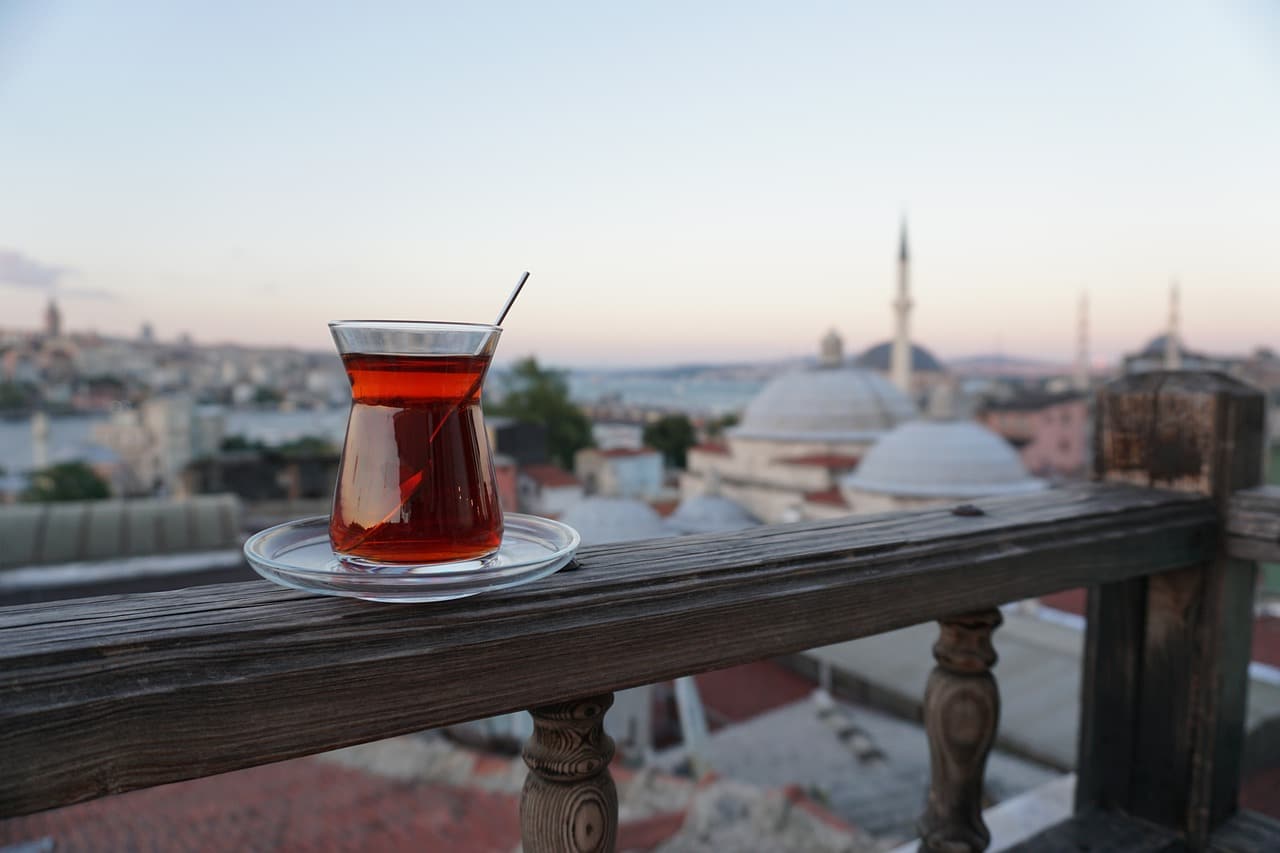
Istanbul Beverage Culture: From Traditional Drinks to Specialty Coffee
Why Istanbul’s Drink Culture Is a Journey in Itself
Ask an Istanbulite what they’re drinking and you’re rarely getting a one-word answer — you’re getting a small story. That’s the first thing to understand about this city: a drink here is an excuse to sit still for a while, and sitting still is something Istanbul takes seriously.
The scene is a study in contrasts, and you’ll feel it within a single afternoon. You can drink a centuries-old fermented grain beverage a few steps from a Roman aqueduct, then cross a bridge and order a nitro cold brew in a converted warehouse café that wouldn’t look out of place in Melbourne. Neither one is “more authentic” than the other — both are what Istanbul actually drinks in 2026.
The reason the drinks matter so much is that they carry the city’s history in a literal, drinkable form:
- Turkish coffee traces back to trade routes from Yemen and the Ottoman court.
- Black tea (çay) reflects a 20th-century agricultural and political decision, not an ancient habit.
- Boza and şalgam are pre-Ottoman survivors from Anatolia’s fermentation traditions.
- Raki carries the weight of the Republic’s secular drinking culture and its Greek, Armenian, and Jewish urban roots.
This guide walks through all of it — what to order, what it actually costs, where the real version is versus the version made for tourists, and the etiquette that will make you look like you’ve done this before. Whether you’re chasing the city’s best third-wave pour-over or just trying to figure out what that purple turnip juice is, you’ll find it below.
The History of Istanbul’s Beverage Culture — A Liquid Timeline
{Image: sepia-toned or archival-style photo of an old Istanbul coffeehouse interior}
Coffee arrives, and the Sultans panic (1550s–1700s)
Coffee reached Istanbul in the early 1550s, credited to Özdemir Pasha, the Ottoman governor of Yemen. The city’s first coffeehouse opened in 1554 in the Tahtakale district, and it didn’t stay small — within decades, coffeehouses had become the closest thing the Ottoman Empire had to a public forum. Men gathered to read, argue politics, watch shadow puppet theatre, and gossip, all over a single cup that bought you a seat for hours.
That’s exactly what worried the Sultans. Sultan Murad IV banned coffee outright in 1633, making its consumption a capital offence — he saw the coffeehouse for what it was: a place where ordinary people traded opinions the state couldn’t monitor. The ban didn’t stick. Neither did a second attempt in 1659. By the 1700s, the coffeehouse had won.
Tea quietly takes over (1920s–1950s)
Here’s the part most guides skip: Turkey’s obsession with tea is not ancient. For nearly 400 years, coffee was the national drink. That changed after WWI, when the newly formed Republic lost Yemen — and with it, affordable access to coffee beans. Coffee became an expensive, unreliable import, and Atatürk’s government looked for a domestic replacement.
The obvious answer was tea, grown in the humid, rainy climate of Rize on the Black Sea coast — but it wasn’t an overnight fix. Early attempts to plant tea in Rize date back to 1912, and they largely failed. It took until 1937, when 20 tons of tea seed were imported from Batumi in neighboring Georgia, for Turkey to produce its first serious harvest. From there, adoption was fast: tea was cheap, easy to brew in bulk, and fit the pace of everyday Turkish life. By the mid-20th century, it had overtaken coffee as the country’s default drink — a position it still holds as the most-consumed beverage in Turkey today.

Older than either of them: fermented Anatolian drinks
Before coffee or tea, Anatolia was drinking fermented beverages that predate the Ottoman Empire entirely. Boza (fermented millet) and şalgam (fermented turnip) both trace back to pre-modern, probiotic-heavy Anatolian diets, and both are still sold on the street today — a genuinely rare case of a pre-imperial drinking tradition surviving into 2026 largely unchanged.
Alcohol’s complicated place in the city
Despite religious prohibition, alcohol was never absent from Istanbul — it was historically produced and consumed by the city’s Greek, Armenian, and Jewish communities, concentrated in neighborhoods like Galata. After the Republic was founded, production of raki was standardized under state-run factories, cementing it as the de facto national spirit and a fixture of secular dining culture, distinct from — and sometimes in quiet tension with — the country’s Islamic majority.
The modern revolution (2000s–today)
The most recent shift is the fastest: the 2010s brought third-wave specialty coffee, independent craft breweries, and a serious re-evaluation of indigenous Turkish wine grapes that had been ignored for decades. The result is that 2026 Istanbul has more genuine beverage diversity — traditional and modern, coexisting rather than replacing each other — than at any other point in its history.
Neighborhood Beverage Guide — Where to Drink What in Istanbul

A quick reference for matching neighborhood to drink, pulling together everything covered above:
Sultanahmet & Fatih — tradition first
This is where the historical drinks live: Turkish coffee with a mosque view, Ottoman sherbet at places like Matbah, and Boza at the genuinely 150-year-old Vefa Bozacısı. Don’t expect cutting-edge coffee here — that’s not what this district is for.
Beyoğlu & Galata — the full spectrum in one walk
Realistically the most versatile drinking district in the city: start with specialty coffee in Galata or Karaköy (Kronotrop, Federal Coffee, Brew Lab), move to a natural wine bar in Cihangir or Tomtom (Solera), and end the night on Nevizade or in Asmalımescit for raki — just budget for Nevizade’s tourist markup if that’s where you land.
Beşiktaş & Ortaköy — casual and Bosphorus-facing
Draft beer and craft taprooms (Craft Beer Lab) in the lively Beşiktaş Çarşı, or a more relaxed tea by the water in Ortaköy with the bridge lit up behind you. Less curated, more everyday-local in feel than Beyoğlu.
Kadıköy & the Asian side — better value, more local crowd
Genuinely the best independent coffee roasters (Petra), solid craft beer, and — as covered in the raki section — meaningfully better-value meyhanes than Nevizade, with a younger, more local crowd. If you only have time for one “authentic but not touristy” drinking neighborhood, this is the strongest pick.
Nişantaşı — the upscale end
Polished café terraces serving flat whites by day, and proper cocktail bars by night. Prices track with the neighborhood — expect to pay more here than almost anywhere else on this list for a comparable drink.
Balat & Fener — photogenic, slower-paced
Concept cafés and traditional tea houses tucked into the colorful historic streets. Good for a slow morning rather than a night out — there isn’t much of a late drinking scene here compared to Beyoğlu or Kadıköy.
Practical Beverage Guide — Costs, Etiquette & Tips
Exchange rate context: as of mid-July 2026, 1 USD ≈ 47 TRY. Prices below reflect current 2026 figures, not older estimates — Turkish lira depreciation means guides even a year or two old will understate real costs meaningfully.
Tea & Turkish coffee
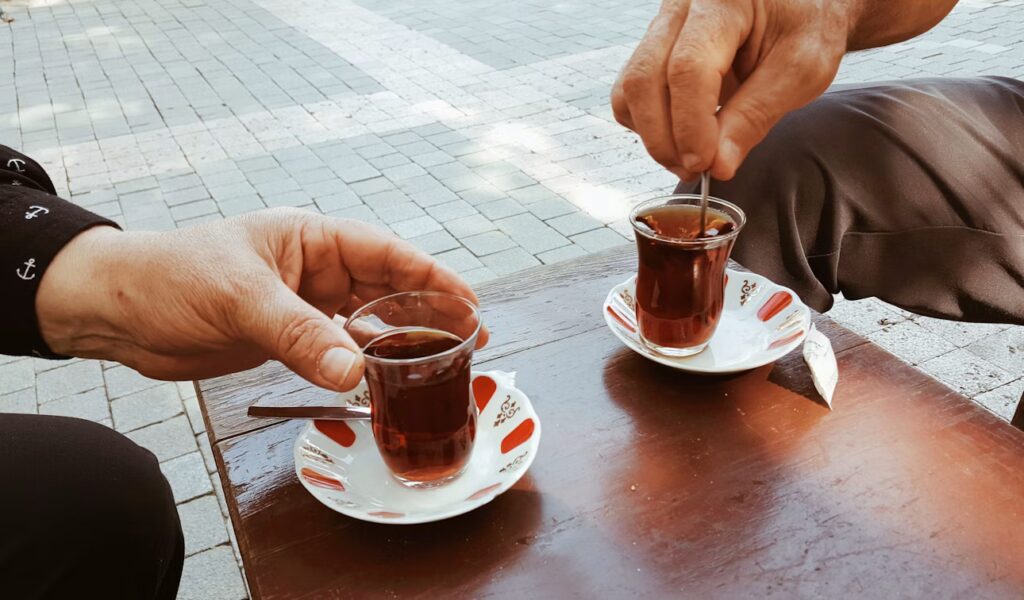
- Black tea (çay): roughly 20–30 TL at a local café (about $0.45–0.65), rising to 60–80 TL at a tourist-facing spot.
- Turkish coffee: expect 80–150 TL at an everyday coffeehouse ($1.70–3.20), more at a destination café like Mandabatmaz during peak hours.
Specialty coffee
- Flat white / V60 pour-over: roughly 150–280 TL ($3.20–6), broadly matching what you’d pay in a mid-range European specialty café — this has genuinely closed the gap with Western pricing over the past few years.
Alcohol — expect this to be the most expensive category
- Domestic beer (Efes): roughly 120–180 TL in a bar ($2.55–3.85), higher at a craft taproom.
- Local wine by the glass: roughly 150–300 TL ($3.20–6.40); a bottle at a restaurant runs 800–1,500 TL.
- Raki: as covered earlier, a full bottle at a meyhane reflects the roughly $34–37/liter retail tax burden — genuinely expensive, which is exactly why it’s shared and sipped slowly.
- Cocktails: 400–800+ TL at a high-end bar ($8.50–17).
Water — a genuine cost trap
Bottled water prices swing wildly by location: a bottle near a major sight like Hagia Sophia can run around 80 TL, while the same bottle at an ordinary corner shop costs closer to 15 TL. Buy water away from tourist landmarks, or carry a bottle and refill from a larger jug bought at a supermarket.
Drinking etiquette — the unwritten rules
- Clink raki glasses at the base, not the rim, as a sign of respect and equality.
- Don’t rush out of a tea garden or café the moment you finish your drink — lingering is genuinely expected, not seen as loitering.
- If a menu is posted in five languages at the entrance, you’re likely paying a tourist markup; better value is usually two or three streets off the main route.
Where alcohol is and isn’t served
Many traditional kebab restaurants (kebapçı) and nearly all esnaf lokantası (tradesmen’s cafeterias) don’t serve alcohol at all. If you want alcohol with your meal, you need a meyhane or a modern restaurant — don’t assume it’s available just because a place serves food.
Water safety
Don’t drink Istanbul’s tap water. Ask for bottled water (su) — restaurants will bring it to your table and add it to the bill, so don’t assume it’s complimentary.
Tipping
Tipping isn’t mandatory, but 5–10% at restaurants is customary if you’re satisfied. For counter-service coffee or tea, a few coins or small bills in the tip jar is standard. Note also that many sit-down restaurants add a kuver (cover charge) automatically — check your bill before assuming a tip is the only extra cost.