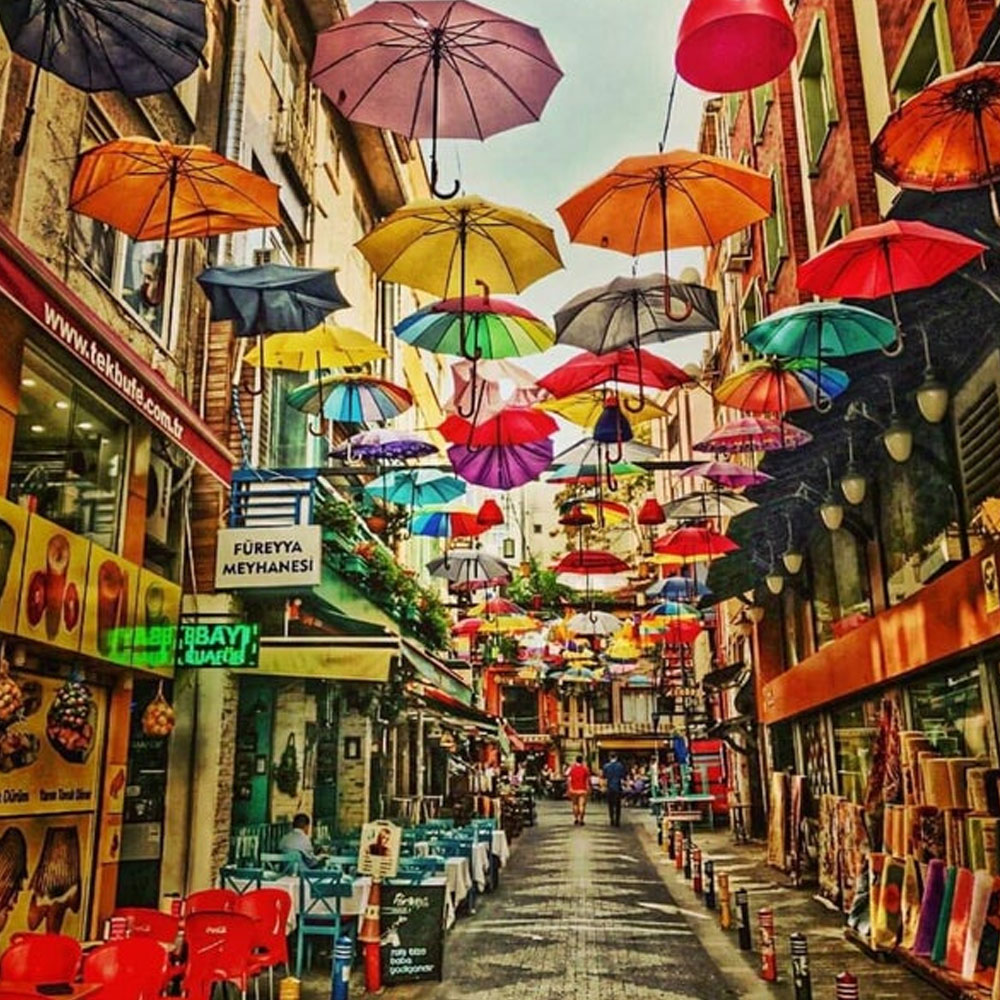
Istanbul for Design Lovers: Studios, Concept Stores & Galleries
Why Istanbul Is a Hidden Capital of Design
Istanbul doesn’t do minimalism. Roman columns hold up Byzantine cisterns. Ottoman calligraphy shares walls with neon shop signs. Glass towers throw shadows over crumbling 19th-century French-style apartment blocks. For most travelers that’s just background noise. For a design lover, it’s the whole point — this city is less a destination than a 3,000-year mood board that never stops updating itself.
That update is happening in real time. In May 2026, Istanbul hosted its first-ever Global Design Forum, staged inside the seventh-century Hagia Irene church within the Topkapı Palace complex — a joint production with London Design Festival built around the theme “Worlds in Contact.” The four-day event combined public installations, digital storytelling, and high-level debate rooted in the city’s heritage and contemporary dynamism. It’s a useful data point, not just a headline: it signals that Istanbul is now formally positioning itself — with UNESCO-backed numbers to match — as a serious node in the international design conversation, not just a heritage backdrop for it. According to UNESCO figures cited around the event, Istanbul’s creative economy employs more than 140,000 professionals and generates close to three-quarters of Türkiye’s total creative-sector turnover.

None of that is why you’re reading this, though. You’re here because you want to know where to actually go.
Who This Guide Is For
This is built for the visually obsessed — the traveler who photographs typography on street signs before landmarks, who’ll walk twenty minutes out of the way for one ceramic studio, who checks a restaurant’s lighting design before the menu. If that’s you, keep reading. If you want a generic “top 10 things to do,” this isn’t that guide — go look elsewhere and come back when you’re ready to go deeper.
How the Design Scene Actually Works Here
One thing standard guides get wrong: they treat Istanbul’s design scene like it’s centralized, walkable in an afternoon, and clearly signposted. It isn’t. It’s deliberately decentralized — tucked into unmarked upper-floor apartments, converted bank vaults, and courtyards with no street-facing sign at all. Google Maps will get you to the right block; it won’t tell you which unmarked door to buzz.
Three things make navigating it easier:
- Look up, not just ahead. A huge share of Istanbul’s galleries and studios operate on the 2nd or 3rd floor of ordinary apartment buildings — the street level tells you nothing.
- Follow local Instagram curators, not just gallery accounts — Istanbul’s design world moves fast, and pop-ups and one-night openings rarely make it onto Google.
- Cross the Bosphorus on purpose. The European side (Karaköy, Beyoğlu, Nişantaşı) and the Asian side (Kadıköy, Moda) have genuinely different creative personalities — polished versus raw — and skipping the ferry means you only see half the story.
Understanding Istanbul’s Design Identity

You’ll get more out of every gallery, studio, and concept store in this guide if you understand the three layers stacked underneath them. Istanbul’s design identity didn’t emerge from nowhere — it’s the visible residue of three very different eras that never fully replaced each other.
Layer One: The Ottoman Legacy — Geometry, Pattern, Meaning
Classical Islamic art avoids figurative representation, so Ottoman designers channeled everything into geometry, floral motifs, and calligraphy instead. That constraint produced real mastery: the hypnotic tile repetitions you’ll see at Rüstem Paşa Mosque, the calculated proportions of Mimar Sinan’s domes. This isn’t decoration for decoration’s sake — it’s a rigorous design system with its own internal logic, and it still shapes how Turkish designers think about pattern, repetition, and negative space today.
Layer Two: Republican Modernism — A Sharp Pivot West
When the Turkish Republic was founded in 1923, the aesthetic pivoted hard toward Western modernism. The new state favored stripped-down, Bauhaus-influenced functionalism — a deliberate visual break from Ottoman ornament. The result, still visible today, is genuinely strange in a good way: severe concrete Republican-era buildings standing shoulder to shoulder with crumbling ornate Ottoman townhouses, neither one yielding ground.
Layer Three: Contemporary Synthesis
The most interesting Turkish design happening right now isn’t choosing between East and West — it’s actively fusing them. A few concrete examples worth knowing before you go, so you recognize the pattern when you see it in a shop or gallery:
- GLIF, an Istanbul-based studio, turned heads at Maison & Objet in Paris in early 2026 with work explicitly built around bridging Turkish heritage and contemporary form.
- Dice Kayek, founded by sisters Ece and Ayşe Ege, has spent three decades merging Ottoman grandeur with Parisian tailoring precision — their 2013 “Istanbul Contrast” collection won the Jameel Prize at London’s V&A, which tells you this synthesis approach isn’t a recent trend chasing tourists; it has real institutional credibility behind it.
- Product designers are hammering copper using centuries-old techniques to build minimalist lighting fixtures. Graphic designers are pulling kufic calligraphic forms into sharp, Latin-alphabet branding.
Why the Tension Matters
“East meets West” is a cliché, but it undersells what’s actually happening — it’s not a peaceful meeting, it’s friction. The ongoing push-pull between tradition and modernity, secularism and religion, Europe and the Middle East doesn’t get resolved here; it gets productively channeled. That friction is arguably the single biggest reason Istanbul’s design output feels bolder and less safe than a lot of Western contemporary design right now.
A mistake first-timers make: treating “Ottoman” and “modern Turkish” as two separate itinerary categories — museums for one, galleries for the other. The whole point is that the best contemporary work is in conversation with the historical layer underneath it. Visit Rüstem Paşa Mosque’s Iznik tiles the same week you visit a contemporary ceramics studio in Kadıköy, and you’ll actually see the throughline instead of two disconnected experiences.
Design-Forward Dining & Hospitality Spaces
{image: Elegant restaurant interior with panoramic Istanbul skyline view}
In Istanbul’s top tier, spatial design and lighting genuinely compete with the menu for your attention — the city’s leading architects and interior designers regularly collaborate directly with chefs on these spaces.
Istanbul’s Most Beautifully Designed Restaurants
- Mikla — sleek, retro-modernist, and deliberately restrained, sitting atop The Marmara Pera Hotel in Tepebaşı. The design intentionally stays out of the way of its real centerpiece: a staggering panoramic view over the Golden Horn. Holds a Michelin star as of the 2026 guide, and books out well in advance for sunset seating — request a terrace table specifically when reserving.
- Nicole — set on the top floor of the historic Tomtom Suites building, itself a former convent (Soeurs Garde-Malades, built 1901) that once housed the Franciscan nun the restaurant is named after. Quiet, intimately lit, contemporary Anatolian cuisine under chef Serkan Aksoy — also Michelin-starred.
- Neolokal — housed inside SALT Galata (Section 4), with soaring windows and an open, high-tech-lab-style kitchen under chef Maksut Aşkar. Currently holds both a Michelin Star and a Michelin Green Star for sustainability — genuinely one of the strongest design-plus-substance combinations on this whole list.
Honest note on booking: all three require reservations well ahead, especially for weekend or terrace seating — don’t assume you can walk into any of these on a whim, even outside peak season.
Boutique Hotel Design Worth Staying In (or Just Visiting)
- Soho House Istanbul — housed in the breathtaking Palazzo Corpi, the former US Embassy building, where Soho House’s signature eclectic, velvet-heavy design sits layered directly over original 19th-century frescoes and Carrara marble. A genuinely striking contrast worth seeing even if you’re not a member — some public-facing spaces and events are accessible to non-members, so check current access policy directly.
- The Stay Bosphorus — designed by Autoban (Section 8), with custom furniture and lighting and a layout built specifically to maximize dramatic Bosphorus views. A useful stop if you want to see Autoban’s hospitality work in person rather than just the showroom pieces.
- Georges Hotel Galata — a strong adaptive-reuse example: stripped-back brick, soaring ceilings, and sleek minimalist furniture inside a 19th-century apartment block.
- Vault Karaköy — a converted bank, preserving the original steel vaults and marble staircases from its former life while layering in modern luxury. A genuinely fitting choice given how much of Karaköy’s broader design identity (Section 3) is built on exactly this kind of adaptive reuse.
Cafés as Design Experiences
Many third-wave coffee shops in Moda and Karaköy function as informal design showrooms — the chair you’re sitting in or the print on the wall is frequently for sale, tying directly back to the Moda café-retail hybrid model covered in Section 7. Minoa, a multi-level independent bookstore and café in Akaretler, is a strong standalone stop for this — it reads more like a meticulously designed private library than a commercial café.
Design-Serious Nightlife
Istanbul’s high-end nightlife venues along the Bosphorus are genuine feats of acoustic and spatial engineering — designed to deliver open-air waterfront dancing while managing strict noise regulations in a dense residential city. Worth knowing about even if clubbing isn’t your priority, since the engineering problem itself is a legitimately interesting design challenge.
Practical Design Lover’s Guide to Istanbul

Where to Base Yourself
Stay in Galata, Cihangir, or Karaköy to be within walking distance of the highest concentration of galleries, studios, and concept stores covered in this guide — Sections 3, 5, 7, and 8 all cluster heavily around this stretch. If you’re planning serious Asian-side time in Kadıköy and Moda, staying centrally on the European side and ferrying over still works better than splitting your nights, since the ferry itself (20–25 minutes, covered in Section 3) is part of the experience, not just transit.
Best Time of Year for Design Programming
September and October remain the strongest window, anchored by two confirmed, dated events: Contemporary Istanbul (2026 edition starts September 24, marking its 20th anniversary — Section 10) and the gallery season openers that typically cluster around the same period across Karaköy and Nişantaşı. Autumn weather is also genuinely pleasant for the amount of walking this itinerary requires.
One honest caveat, since we corrected this earlier: don’t plan around the Istanbul Design Biennial happening on a predictable autumn schedule — it’s been dormant since its last confirmed edition in 2020–2021. If a Global Design Forum Istanbul follow-up edition gets announced for 2027, that would land in May instead, based on the 2026 debut timing (Section 1 and 10).
Essential Resources Before You Travel
- Reading: Thomas F. Madden’s Istanbul: City of Majesty at the Crossroads of the World for architectural and historical context; SALT’s own exhibition catalogs for design-specific deep dives.
- Instagram: follow the galleries and institutions named throughout this guide directly — @arter, @istanbulmodern, @saltonline, plus individual gallery accounts — since exhibition calendars on websites often lag behind what’s posted socially (a point that came up repeatedly in Section 5).
- Websites: Cornucopia Magazine remains the strongest English-language source for ongoing coverage of Turkish art, antiques, and design.
Budgeting for a Design Trip
Based on everything verified throughout this guide, here’s a realistic breakdown (at roughly 46–47 TRY/USD):
| Category | Typical cost |
| Commercial galleries (Section 5) | Free |
| Arter | ~$1.30, free on Thursdays |
| Istanbul Modern | ~$7–8 |
| Museum of Turkish & Islamic Arts | ~€17 |
| Topkapı Palace (combined ticket) | ~$60 |
| Hagia Sophia | €25 |
| Chora Church / Kariye | €20 |
| Half-day craft workshop (Ebru, tile painting) | $50–100 |
| SALT Beyoğlu / SALT Galata | Free |
The pattern worth noting: the free stuff (commercial galleries, SALT, most concept-store browsing) is where the real design discovery happens in this guide. The paid stops are almost all historical/state sites. Budget accordingly — a genuinely rich design-focused day can cost very little beyond transit and coffee.
Design-Focused Tour Operators & Private Guides
If you want access to private architectural sites, VIP gallery previews, or curator-led walks that are genuinely impossible to arrange solo, specialized boutique agencies exist specifically for this. Worth the cost if you’re short on time or pursuing serious collecting (Section 14).
Accessibility
Major modern institutions — Istanbul Modern, SALT, Zorlu Center — are fully accessible. Independent galleries in historic 19th-century Beyoğlu apartment buildings (a large share of what’s covered in Sections 5 and 7) frequently lack elevators and involve steep, narrow stairs. If mobility is a concern, call ahead rather than assuming.
Sample Design Itineraries
One Day — The Essential Circuit
- Morning: Istanbul Modern (Karaköy) for contemporary Turkish art.
- Lunch: Neolokal, inside SALT Galata.
- Afternoon: Serdar-ı Ekrem Street and the surrounding Galata boutiques — Der Liebling, Vitruta, Sofa Art and Antiques (Sections 3 and 7).
- Evening: Drinks at Soho House Istanbul for the Palazzo Corpi interior.
Two Days — Galleries, Concept Stores & Studios
- Day 1: SALT Beyoğlu, Pera Museum, a stop at Galerist or Dirimart, then concept-store browsing in Nişantaşı.
- Day 2: Ferry to Kadıköy, Yeldeğirmeni street art walk, independent ceramic studios in Moda, Ara Güler Museum in Bomontiada.
Three Days — Architecture, Craft & Collecting
- Days 1–2: As above.
- Day 3: Morning Ebru or calligraphy workshop in Sultanahmet (~€55, Section 12), afternoon in Çukurcuma’s antique shops (mind the export rules from Section 14), evening at a commercial gallery in Karaköy.
Four Days — The Art Collector’s Programme
- Day 1: Contemporary Istanbul (if your dates align with its September fair) or a full gallery circuit through Dolapdere and Pera.
- Day 2: Private visits to Dirimart and x-ist, ideally arranged through a local art advisor.
- Day 3: Studio visits in Bomonti and Kadıköy — remember the Instagram-outreach etiquette from Section 8.
- Day 4: Sakıp Sabancı Museum in the morning, finalize any purchases (with proper documentation, per Section 14), dinner at Mikla.