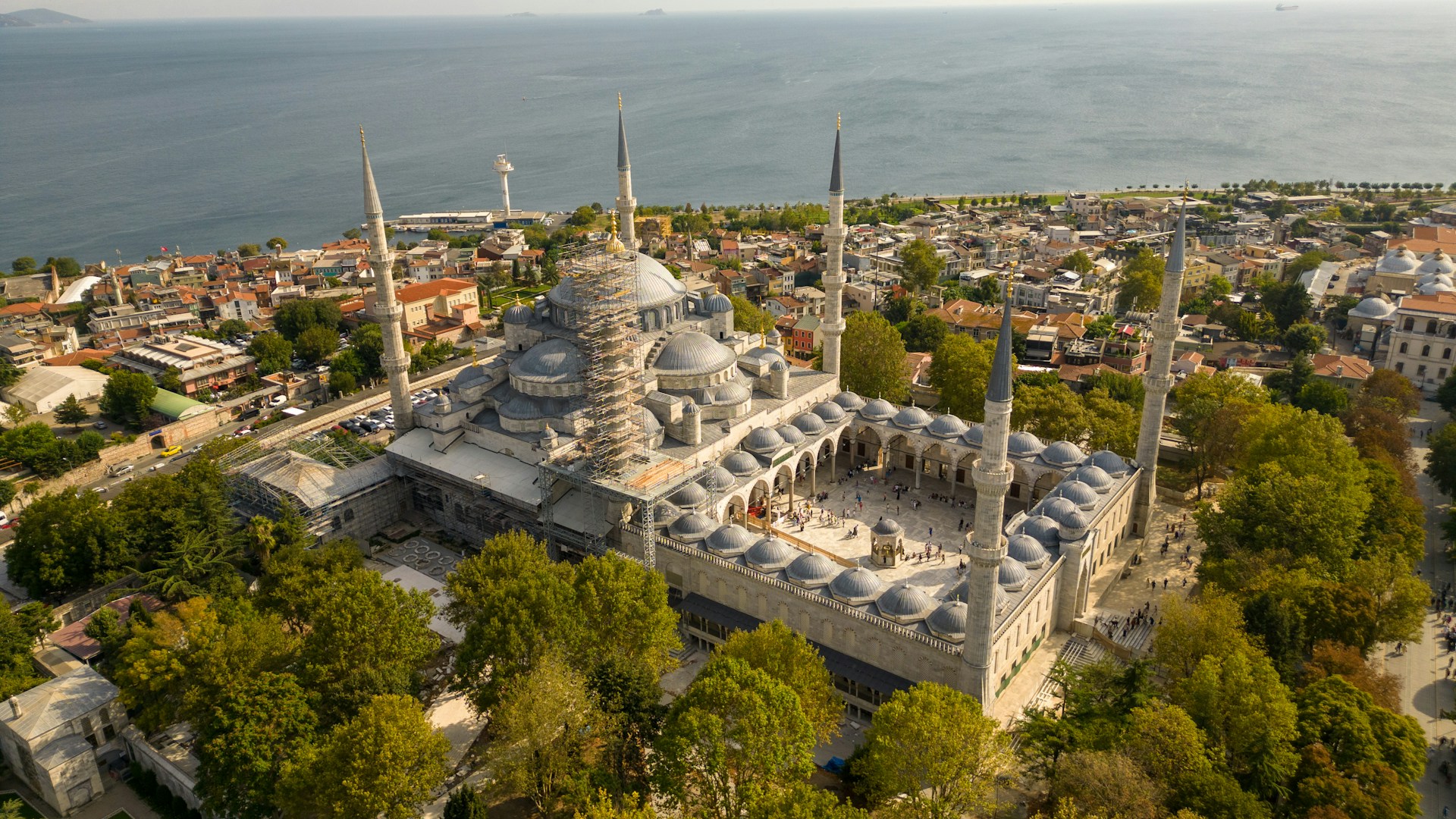
If Istanbul is where East meets West, the historic peninsula — Sultanahmet and the wider Fatih district — is the exact hinge point. This triangle of land at the tip of the European shore has been the seat of power for two empires across roughly 1,600 years: Rome (after Constantine moved the capital here in 330 AD, and its direct continuation, the Byzantine Empire) and, from 1453 onward, the Ottomans. Most guides tell you “three empires ruled here.” That’s not quite right — Byzantine is the Roman Empire’s eastern half, not a separate one. But you don’t need the correction to feel the weight of it: walk these streets and you’re crossing over buried palaces, a 1,600-year-old chariot-racing track, and the exact ground where emperors and sultans rewrote the map of the world.
What makes this corner genuinely unlike anywhere else
Stand in Sultanahmet Square and pivot 180 degrees. On one side: the Hagia Sophia, a 6th-century engineering feat that held the record for the world’s largest cathedral for close to a thousand years. On the other: the Blue Mosque, a 17th-century answer to it. You’re standing on the buried outline of a Roman hippodrome the whole time. Nowhere else stacks that much history into a space you can walk across in under ten minutes.

{Image placeholder: aerial or map graphic showing Sultanahmet peninsula outline with Golden Horn, Bosphorus, Marmara labeled}
How much time do you actually need?
Two to three full days is the realistic minimum if you want more than a highlight reel. You can do the “big four” — Hagia Sophia, Blue Mosque, Topkapı, Grand Bazaar — in one long, exhausting day. But that leaves out the Basilica Cistern’s newly restored galleries, the residential quiet of Süleymaniye’s backstreets, and Balat’s stairstep lanes — the parts that make people say Istanbul, not just “we saw the sights.” Budget accordingly, and wear shoes you’ve already broken in — the cobblestones here are not forgiving.
Orientation — Understanding the Layout of Historic Istanbul
Where exactly is Sultanahmet?
Sultanahmet sits on the easternmost tip of Istanbul’s historic peninsula, on the European side. Water wraps it on three sides: the Golden Horn to the north, the Bosphorus to the east, the Sea of Marmara to the south. It’s the oldest, most fortified real estate in the city — which is exactly why every empire that took Istanbul put its palace here.
Sultanahmet vs. Fatih — what’s the actual difference?
Sultanahmet is a small neighborhood inside the much larger district of Fatih, which stretches all the way west to the Theodosian land walls. In practice, “Sultanahmet” means the compact tourist core around Hagia Sophia and the Blue Mosque. “Fatih” means everything else on the peninsula — residential, conservative, and largely unbothered by tourism. Knowing this distinction matters for one practical reason: prices, crowd levels, and the general vibe change dramatically the moment you step out of the Sultanahmet core.
The Seven Hills — your mental map for the rest of this guide
Like Rome, old Constantinople was built across seven hills, and later Ottoman sultans crowned each one with an imperial mosque. This isn’t just trivia — it’s the fastest way to understand why the peninsula’s skyline looks the way it does, and it’ll help you place everything else in this guide:
- 1st Hill — Topkapı Palace, Hagia Sophia, Blue Mosque (the Sultanahmet core)
- 2nd Hill — Nuruosmaniye Mosque, the Grand Bazaar, Column of Constantine
- 3rd Hill — Süleymaniye Mosque, Beyazıt Mosque, Istanbul University
- 4th Hill — Fatih Mosque, the Conqueror’s tomb
- 5th Hill — Yavuz Sultan Selim Mosque, overlooking Fener and the Greek Patriarchate
- 6th Hill — Mihrimah Sultan Mosque, near Edirnekapı and the land walls
- 7th Hill — Aksaray to the Theodosian Walls, the least-visited of the seven
Your calves will know exactly which hill you’re on by the end of the day — this is not a flat city.
Walking distances — what’s actually reachable on foot
Inside the Sultanahmet core, everything is stitched together tightly:
- Blue Mosque → Hagia Sophia: about 2 minutes
- Hagia Sophia → Topkapı Palace: about 5–7 minutes
- Sultanahmet core → Grand Bazaar: roughly 15 minutes
Deeper Fatih — Balat, Fener, the Chora Church — is a different story. Those are 3–5 km away and need the tram, a bus, or a taxi. Don’t try to “just walk it” after a full day of sightseeing; it’s further than it looks on a phone screen.
The Iconic Landmarks of Sultanahmet — The Must-Sees
Hagia Sophia — The Building That Rewrote History
{Image placeholder: interior shot of the central dome, Hagia Sophia}
From cathedral to mosque to museum and back again
Emperor Justinian built the Hagia Sophia (Ayasofya) in 537 AD, and it held the record for the world’s largest cathedral for nearly a thousand years. Mehmed II converted it into a mosque after the 1453 conquest. Atatürk’s government turned it into a museum in 1935, and in July 2020 it reverted to a working mosque — a decision that’s still debated among historians and UNESCO, since Hagia Sophia has been a World Heritage Site since 1985.
What to see inside
The dome itself is the headline act — 31 meters across, and it still looks structurally implausible from underneath. Look for the Byzantine mosaics of Christ, the Virgin Mary, and various emperors, sitting a stone’s throw from massive gold-calligraphy medallions from the Ottoman period — that layering is the whole point of visiting. Don’t skip the “weeping column” in the northwest corner, worn smooth by centuries of visitors pressing a thumb into its damp hole and making a wish.
Visiting tips — queues, dress code, and what actually changed
Here’s where a lot of older guides get it wrong: since January 2024, foreign tourists pay a flat €25 fee and use a separate tourist entrance that leads only to the upper gallery. The ground floor is reserved exclusively for worshippers — you won’t get down there as a tourist, full stop. A few things worth knowing before you go:
- Hours: roughly 8:00 AM–7:00 PM in summer (April–October), from 9:00 AM in winter
- Friday closures: shut to tourists during Friday congregational prayer, typically 12:00–2:30 PM
- Istanbul Museum Pass does NOT cover Hagia Sophia — you need this ticket separately regardless of any pass you’re carrying
- Dress code: shoulders and knees covered, headscarf for women (free scarves at the entrance, but bring your own to save time)
- Children under 8 enter free with ID
Arrive at opening or in the last hour before close to dodge the worst of the queue — the online ticket saves you the counter line but not the security line.
The Blue Mosque (Sultan Ahmed Camii) — A Living, Breathing Wonder
The story behind the six minarets
Sultan Ahmed I commissioned this mosque (1609–1617) to answer the Hagia Sophia. Six minarets was a genuinely bold, borderline scandalous choice at the time — only the Grand Mosque in Mecca had six. As the story goes, Ahmed had to fund a seventh minaret for Mecca to smooth things over.
Inside — tiles, light, and where things stand after restoration
The years-long restoration is largely finished: the central dome and the more than 20,000 hand-painted İznik tiles are fully visible again after being boxed off behind scaffolding for years. One section — the Hünkar Kasrı (Imperial Pavilion) — remains closed for continued work as of 2026, but it doesn’t affect the main visitor experience. Over 200 stained-glass windows still flood the interior with color, and the tulip, carnation, and lily motifs on the tiles are worth slowing down for.
Visitor rules and practical entry
- Entry is free — no ticket, ever
- Closes to tourists briefly five times a day for prayer, and for a longer stretch around Friday midday prayer (roughly until 2:30 PM) — don’t plan a Friday-noon visit
- Typical hours run about 8:30 AM–6:30 PM, but the exact windows shift around prayer times
- Shoes off, stored in the cubbies at the entrance; same dress code as Hagia Sophia
Topkapı Palace — The Heart of the Ottoman Empire

A room-by-room guide to the four courtyards
For nearly 400 years this was the Ottoman sultans’ administrative headquarters and home. The Second Courtyard holds the palace kitchens and Imperial Council chamber; the Third has the Sultan’s private quarters and the Library of Ahmed III; the Fourth opens up into a series of garden pavilions with sweeping Bosphorus views.
The Harem — and an important ticket correction
The Harem is arguably the most compelling part of the palace — not the “pleasure garden” of Western imagination, but a highly structured, genuinely political institution run by the Valide Sultan (Queen Mother). Its tile work rivals anything else in the city.
Here’s the correction: older advice (including a lot of what’s still published online) tells you the Harem needs a separate ticket. That changed — as of the 2025/2026 season, Topkapı sells one combined ticket covering the main palace, the Harem, and Hagia Irene church together. There’s no longer an à la carte option, so don’t budget for a second ticket purchase at the door.
The Treasury — diamonds, daggers, and relics
The Treasury houses the Spoonmaker’s Diamond (an 86-carat teardrop stone) and the jewel-encrusted Topkapı Dagger. The Pavilion of the Holy Mantle holds relics attributed to the Prophet Muhammad — a space of genuine religious weight, where the Quran is recited around the clock.
Practical info
- Combined ticket (Palace + Harem + Hagia Irene): roughly 2,750 TL for foreign visitors (about €55 — expect this figure to drift with the lira, so treat it as a ballpark)
- Closed Tuesdays — plan your route accordingly
- Hours: roughly 9:00 AM–5:00 PM (ticket office), palace closes a bit later; shorter hours in winter
- Budget 2–3 hours minimum, more if the Archaeology Museums on the grounds interest you
The Hippodrome (Sultanahmet Square) — An Outdoor Museum
The Obelisk of Theodosius and the Serpent Column
The long park running beside the Blue Mosque was once the sporting and social heart of Byzantine Constantinople. Two ancient survivors still stand here: the Obelisk of Theodosius, an Egyptian monument originally carved around 1490 BC and hauled here from Karnak by Emperor Theodosius in 390 AD, and the Serpent Column, a bronze piece cast in 479 BC to commemorate a Greek victory over the Persians at Plataea.
What the Hippodrome looked like in Byzantine times
Picture a U-shaped stadium holding around 100,000 people watching chariot races — brutal, high-stakes entertainment that doubled as political theater. It’s also where the Nika riots of 532 AD broke out, a revolt that nearly toppled Emperor Justinian and ended with tens of thousands dead.
The German Fountain — a forgotten gift
At the Hippodrome’s northern end sits the German Fountain, an octagonal neo-Byzantine structure gifted to the city by Kaiser Wilhelm II in 1898 to mark his state visit. Look up — the gilded mosaic ceiling is the best part, and most people walk right past it.
Basilica Cistern — Istanbul’s Mysterious Underground World
The Medusa heads — fact, fiction, and why they’re upside down
Built in 532 AD under Justinian I to supply water to the Byzantine palaces, this underground hall holds 336 marble columns rising straight out of shallow water. In the far corner, two columns rest on carved Medusa heads — one sideways, one upside down. Nobody actually knows why. The romantic theory says it was deliberate, to neutralize her mythical stone-turning gaze. The boring, more likely theory: the builders needed blocks of a specific height and grabbed whatever recycled Roman spolia fit the space. Both explanations get repeated as fact online — treat it as an open question, not settled history.
Restoration — and a heads-up on recent turbulence
The cistern underwent a major restoration between 2020–2022, adding seismic reinforcement, a new steel walkway system, and dramatic color-shifting lighting that plays across the brickwork. That’s the good news, and it’s still true today.
Here’s the part most guides won’t tell you: in June 2026, management of the cistern was transferred from Istanbul’s municipal government to Turkey’s General Directorate of Foundations amid an ownership dispute — the site was briefly closed to the public while new ticketing was installed, then reopened about a week later. It’s operating normally as of this writing, but given the site’s history of sudden administrative closures, it’s genuinely worth a quick check of current hours and ticket prices a day or two before you go, rather than trusting any fixed number here or elsewhere.
Best time to visit without the crowds
This is one of the most-queued sites in Sultanahmet, with waits reaching 60–90 minutes at midday in peak season. Go right at opening (9:00 AM) or within the last hour before close. As an indoor, cool, humid space, it also doubles as a good midday escape from summer heat.
Getting To, Around & Out of Sultanahmet & Fatih
Arriving from Istanbul Airport (IST) — the actual route
Here’s the full, accurate route, since a step gets skipped in a lot of guides: take the M11 metro from the airport to Gayrettepe (about 30–35 minutes), transfer to the M2 metro toward Yenikapı, and get off at Vezneciler (also called Laleli–İstanbul Üniversitesi). From there it’s a 10–15 minute walk into Sultanahmet, or a short hop on the T1 tram. All in, budget 75–90 minutes and roughly 120–150 TRY with an Istanbulkart — a fraction of a taxi.
Important: the M11 doesn’t run 24 hours — service stops around midnight and resumes at 6:00 AM. If you’re landing overnight, you’ll need the Havaist bus (which runs 24/7 but doesn’t drop you directly in Sultanahmet — the closest stop is Aksaray, a short tram ride or 15-minute walk away) or a taxi/private transfer.
Havaist bus vs. private transfer
Havaist buses run from the airport to Aksaray, roughly a 60–90 minute ride depending on traffic, for a fraction of a taxi’s cost. If you’re arriving with heavy luggage or landing very late at night, a pre-booked private transfer removes the guesswork — worth the extra cost for a stress-free arrival after a long flight.
Walking routes that connect the highlights
A workable one-day route: start at Topkapı Palace in the morning, move down to Hagia Sophia and the Blue Mosque by midday, stroll the Hippodrome, and finish at the Grand Bazaar by late afternoon (remembering it closes Sundays — see the Grand Bazaar section above).
Tram T1 — the neighborhood’s backbone
The T1 tram line connects the Grand Bazaar, Sultanahmet, and the Spice Bazaar directly to the ferry docks and across the Galata Bridge into Beyoğlu. Get an Istanbulkart on arrival and use it constantly — trams, buses, metro, and ferries all run on the same card.
Never drive here
Don’t rent a car for this part of the city. The streets are narrow, historic, frequently blocked by delivery trucks, and largely pedestrianized around the major sites. It’s simply not built for it.
Getting back to your hotel — and an honest note on Uber
Taxis in Sultanahmet have a real reputation for overcharging tourists, especially with the meter “forgotten” or a long way round taken. Here’s the correction worth knowing: Uber does technically work in Istanbul, but it isn’t the private-driver service you might expect elsewhere — legally, it operates as a dispatch layer for the city’s licensed yellow and turquoise taxis, not independent drivers. That means it doesn’t reliably get you a better price than a metered taxi; its real value is the GPS tracking and the fact that a fare estimate shows up before you ride. BiTaksi is the more widely used local alternative and functions similarly. Either way, always confirm the driver is using the meter (or the app’s fare) rather than negotiating a flat price on the street.
Where to Stay in Sultanahmet & Fatih
Budget hostels and guesthouses
The streets tumbling downhill from the Blue Mosque toward the sea — the Akbıyık Caddesi area — are packed with clean, sociable backpacker hostels and budget guesthouses, many with their own small rooftop terraces.
Mid-range hotels with the best location value
Look at boutique hotels in restored Ottoman-era wooden buildings around Sirkeci. It’s flat (a genuine advantage on these hilly streets), sits right on a major tram/Marmaray interchange, and is a five-minute walk from both Hagia Sophia and the waterfront.
Luxury hotels with Marmara and Bosphorus views
For a genuine splurge, the Four Seasons Sultanahmet — housed in a converted former Ottoman prison — remains one of the most distinctive luxury stays in the city, and its Rooftop bar (confirmed open to non-guests, as noted earlier) is a good reason to visit even if you’re not staying there. Several boutique properties along the old city walls also offer sweeping Marmara views at a lower price point.
Sultanahmet as a base vs. a day trip
- Stay in Sultanahmet if: history and walkability to the major sights are your priority, and you don’t mind a quieter, more conservative evening scene.
- Visit as a day trip if: nightlife, contemporary dining, and a livelier evening atmosphere matter more to you — in which case, basing yourself in Beyoğlu or Karaköy and taking the tram in makes more sense.
Practical Tips for Visiting Historic Istanbul
Best time of year to visit
Spring (April–May) and autumn (September–October) are the sweet spot — mild weather, good light, and noticeably thinner crowds than the July–August peak.
Best time of day for each major sight — updated with what you now know
- Topkapı Palace: right at opening to beat the cruise-ship groups; remember the ticket now includes the Harem and Hagia Irene automatically (see the landmarks section above) — no separate purchase needed.
- Hagia Sophia: late afternoon works well for light, but don’t cut it too close to the 7:00 PM closing (winter closing is earlier), and avoid the Friday midday prayer closure window entirely.
- Basilica Cistern: the evening “Night Shift” program (roughly 7:30–10:00 PM) runs later than the daytime ticket window and is genuinely worth it for the lighting — though given 2026’s ownership changes (covered earlier), confirm current hours before building your evening around it.
- Grand Bazaar: mid-morning, right as shops open — and never on a Sunday, since it’s closed.
How many days do you really need?
Two full days covers the essentials: the “Big Four” (Hagia Sophia, Blue Mosque, Topkapı, Grand Bazaar) on day one, and the deeper neighborhoods, Sinan’s mosques, and the waterfront on day two. Three-plus days lets you add Fatih, Balat, Fener, and a day trip.
Guided tours vs. self-guided
For Topkapı Palace and Hagia Sophia, a licensed guide genuinely adds value — the layered Byzantine/Ottoman history isn’t always obvious from a placard. For neighborhoods like Balat or wandering the bazaars, self-guided is arguably better; getting a little lost is part of the experience.
Accessibility — cobblestones, hills, and mobility considerations
Be honest with yourself about this one: Sultanahmet is genuinely tough on mobility. Sidewalks are narrow and uneven, cobblestones are historic (meaning: not smooth), and the slopes down toward the water and the Golden Horn are steep. The T1 tram itself is wheelchair accessible, but getting to and from tram stops over cobblestones is the harder part. Taxis are often the more practical option for shorter hops if mobility is a concern.
Photography tips
Arrive at sunrise — the squares around Hagia Sophia and the Blue Mosque are close to empty around 6:30 AM, with good low-angle light on the domes. It’s also simply a calmer, more atmospheric way to experience the space before the tour groups arrive.
Sample Itineraries for Sultanahmet & Fatih
One perfect day
- Morning: Topkapı Palace, including the Harem (now part of the single combined ticket)
- Midday: Hagia Sophia, then lunch at an esnaf lokantası
- Afternoon: Basilica Cistern (check current hours given 2026’s administrative changes), then a stroll through the Grand Bazaar (Monday–Saturday only)
- Evening: A rooftop drink or dessert at Seven Hills or the Four Seasons Rooftop, overlooking the illuminated mosques
Two days — going deeper into the Byzantine and Ottoman layers
- Day 1: The classic route — Topkapı, Hagia Sophia, Blue Mosque, Basilica Cistern
- Day 2: Spice Bazaar, Süleymaniye Mosque, the hidden tiles at Rüstem Paşa, and street food along the Eminönü waterfront
Three days — including Fatih, Balat, Fener, and Eyüpsultan
- Days 1–2: As above
- Day 3: Fatih Mosque, the colorful streets of Balat and Fener, the Chora Church/Kariye Mosque (€20 entry, closed Fridays — see earlier section), finishing with tea at Pierre Loti Hill via the TF2 cable car
The history obsessive’s five-day deep dive
Five days gives you room for the Theodosian Walls, a full day genuinely getting lost in the Grand Bazaar’s specialized sections, Küçük Ayasofya, and a ferry day trip to the Princes’ Islands. One adjustment from the original plan: skip the Mosaic Museum for now, since it’s closed for restoration with no announced reopening date — swap in extra time at Hagia Sophia’s mosaic-filled upper gallery or the Chora Church instead.
Conclusion — Historic Istanbul Will Stay With You
Sultanahmet and Fatih aren’t places you simply visit — they’re places you feel. The weight of two millennia of empire, the smell of roasted coffee and old stone, the call to prayer echoing between domes at sunset: none of it photographs quite the way it feels standing there. Step even slightly beyond the main tourist queues, into Balat’s steep lanes or a büryan lunch in Kadınlar Pazarı, and you’ll find a city that’s still as layered, chaotic, and alive today as it was a thousand years ago — just with a few more ticket machines and a lot fewer camels.