Istanbul doesn’t really have “museums” in the way Paris or London does. It has a Byzantine cathedral that’s a working mosque, a Roman cistern you visit by candlelight-style lamps under your feet, and a sultan’s palace where the kitchen alone is bigger than most European castles. The line between “historic site” and “everyday city” barely exists here — you’ll walk past a 5th-century aqueduct on your way to buy socks.
That’s the good news. The bad news is that this city has quietly become one of the more expensive and more confusing places in the world to plan a museum-going trip. Entry fees for foreign visitors have roughly doubled since 2023. Half the “top attractions” on any list are now active mosques with prayer-time closures you won’t find printed on the ticket. And nearly every guide still tells you the Museum Pass covers Hagia Sophia. It doesn’t, and hasn’t since 2020.
This guide sorts through all of it: what’s actually worth your money, what to skip, how the passes really work, and the mistakes that eat up half a day if you don’t know about them.
The One Thing That Changes Everything: Mosque vs. Museum
Here’s the nuance almost every generic guide glosses over, and it matters more than any ticket price.
For decades, Istanbul’s most famous Byzantine buildings — Hagia Sophia, the Chora Church (Kariye) — operated as secular museums. You bought a ticket, wandered at your own pace, and that was that. Since 2020, both have been reconverted into active mosques. That single administrative shift changed almost everything about how you visit them:
- They close for prayer. Five times a day, non-worshippers are cleared out for roughly 30–90 minutes. Friday is the big one — both sites are largely off-limits to tourists until early-to-mid afternoon because of the congregational prayer.
- A dress code is enforced, not suggested. Covered shoulders and knees for everyone, a headscarf for women. Coverings are handed out free at the door, but bringing your own scarf or shawl saves you standing in a second line.
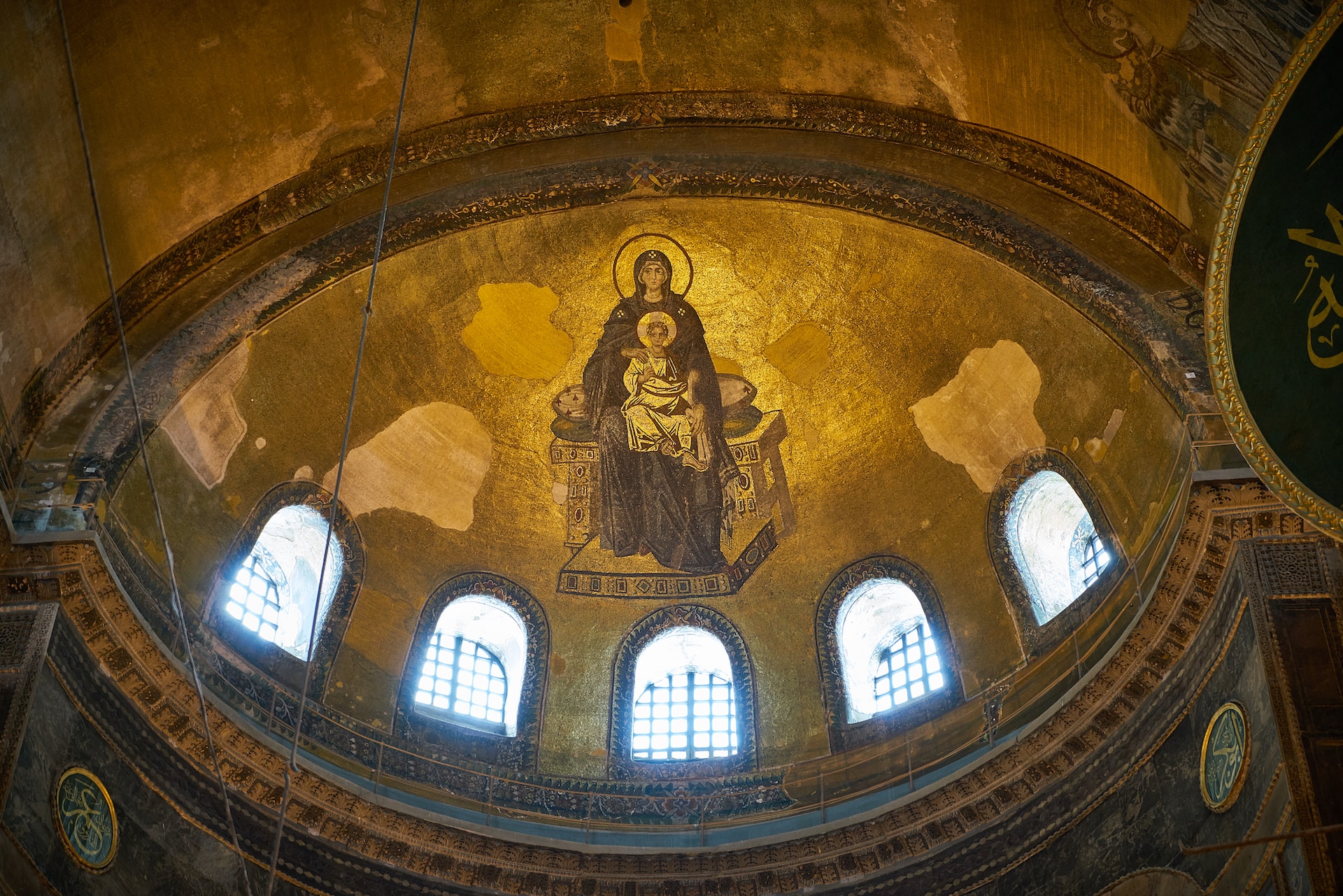
- You no longer roam freely. At Hagia Sophia specifically, tourists are now confined to the upper gallery via a dedicated route. The ground-floor prayer hall — where the famous Deesis mosaic view and several other details sit — is for worshippers only.
- The Istanbul Museum Pass doesn’t work here. Both sites charge their own separate ticket, sold nowhere near a discount, because as functioning mosques they sit outside the state museum system the pass covers.
Keep that mosque/museum distinction in your head as you plan, because it explains almost every “wait, why isn’t this included” moment travelers run into.
{Image: Tourists queueing at Hagia Sophia’s dedicated northeast tourist entrance}
Sultanahmet: The Historic Core
Everything in this section sits within a 10-minute walk of the Hippodrome, and you can realistically cover it in one long day if you start early and skip the Friday midday window.
Hagia Sophia
Built in 537 AD as a Byzantine cathedral, converted to a mosque after the Ottoman conquest, turned into a secular museum in 1935, then reconverted to a mosque in 2020 — Hagia Sophia has effectively lived three different lives, and you can feel all three at once inside it. Byzantine gold mosaics sit under Ottoman calligraphic roundels the size of dinner tables, and the whole structure still somehow feels like it shouldn’t be able to hold its own dome up.
What to know:
- Tourist entry fee: around €25 per adult, paid at the door (cash or card, euros or lira). Children under 8 enter free with ID.
- The Museum Pass is not valid here.
- Tourists use a separate entrance on the northeast side, near the Sultan Ahmed III Fountain — not the Sultanahmet Square door, which is for worshippers only.
- You’ll only see the upper gallery. The ground floor is prayer space.
- Hours generally run 09:00–19:30, opening earlier in summer. It closes for around 90 minutes on Fridays around midday.
- Guided tours inside are no longer permitted; download an official audio guide app before you arrive if you want context beyond a plaque.
The mistake almost everyone makes: assuming the ticket gets you the whole building. It gets you the balcony. If seeing the full nave from ground level matters to you, that experience simply isn’t for sale anymore — it belongs to worship, not tourism.
{Image: Byzantine mosaic of the Virgin and Child in Hagia Sophia’s upper gallery}
Blue Mosque (Sultan Ahmed Mosque)
Directly across the square from Hagia Sophia, and — refreshingly — still completely free. Six minarets (a source of genuine historical controversy when it was built, since only Mecca’s mosque had six at the time), cascading domes, and more than 20,000 hand-painted İznik tiles giving the interior its blue-grey shimmer.
- Free entry, no ticket, no Museum Pass needed.
- Closes to visitors during the five daily prayers, and stays closed most of Friday morning until roughly 14:30.
- Same dress code as Hagia Sophia. Shoes come off at the door — carry a plastic bag or wear slip-ons, since you’ll be walking on carpet.
- Best window: right at opening (08:30) or mid-afternoon on a weekday, before the tour buses arrive.
Because it’s free and directly across from Hagia Sophia, it’s tempting to treat it as the “quick stop” of the pair. Don’t rush it — the tilework rewards slowing down, and unlike Hagia Sophia, you’re standing in the main worship hall itself, not a balcony looking down at one.
Basilica Cistern
An underground Byzantine water reservoir the size of a cathedral, held up by 336 columns (several recycled from earlier Roman buildings, including the famous upside-down Medusa heads at the base of two columns in the back corner). It’s atmospheric almost to the point of being theatrical — dim lighting, ambient music, water underfoot — and it’s genuinely one of the few sites in the old city where the “wow” doesn’t wear off after five minutes.
- Daytime ticket: roughly 1,950 TL (about €38). Not covered by the Museum Pass.
- There’s also an evening “Night Shift” session (from around 19:30) with a higher separate price and a different atmosphere — more lighting design, less daytime crowd.
- Open daily, roughly 09:00–18:30.
- Visits run 30–45 minutes for most people. Floors can be slippery; skip the heels.
Trust note on pricing: the cistern is one of the few major sites here where prices genuinely vary by source month to month, and it isn’t covered by the state pass — factor that into any “is the pass worth it” math, because a lot of pass marketing quietly implies it’s included when it isn’t.
{Image: Basilica Cistern’s column forest with a Medusa head base visible in the low light}
Topkapı Palace
For nearly 400 years this walled complex — not one building but a whole enclosed city of courtyards, kitchens, and pavilions — was the administrative and residential heart of the Ottoman Empire. It’s the site that most rewards planning ahead, because it’s genuinely large enough to eat an entire morning.
- Combined ticket (palace + Harem): around 2,750 TL (roughly €55).
- The Museum Pass covers the main palace but not the Harem or Hagia Irene — you’ll want the combined ticket if you care about either.
- Closed every Tuesday. Opening hours run roughly 09:00–18:00 (shorter in winter), with the ticket booth closing about an hour before the palace does.
- Realistic visit time: 2.5–4 hours, more if you read the labels and see the Treasury properly.
The nuance a rushed itinerary misses: most visitors see the courtyards first and save the Harem for last — by which point tour groups have arrived and the narrow tiled corridors are jammed. Reverse it. Head straight for the Harem when the gates open at 09:00, before the 10 a.m. group wave, then work back through the Treasury and terraces at a normal pace.
Hagia Irene and the Islamic Arts Museum
Two smaller sites worth folding into the same day if you’re already in the area:
- Hagia Irene sits inside Topkapı’s first courtyard — a rare Byzantine church that was never converted into a mosque, which means its interior feels noticeably different (barer, more austere) than Hagia Sophia’s. Covered by the combined Topkapı ticket but not the base Museum Pass.
- Turkish and Islamic Arts Museum, on the Hippodrome, holds one of the world’s best collections of antique carpets and calligraphy in a former Ottoman palace building. It’s usually far quieter than its neighbors, which alone makes it worth the detour after the Hagia Sophia crowds.
Byzantine Istanbul Beyond Sultanahmet
This is where standard tourist guides thin out — and where the city’s deeper layers actually live.
Chora Church (Kariye)
Tucked into the residential Edirnekapı neighborhood near the old city walls, Chora holds what’s widely considered the finest surviving collection of Byzantine mosaics and frescoes anywhere — richer, in some art historians’ view, than anything left in Hagia Sophia. It reopened in 2024 after years of restoration, and like Hagia Sophia, it now operates as an active mosque.
- Entry fee: around €20. Museum Pass not accepted.
- Closed to tourists all day Friday because of the congregational prayer — plan around this specifically, it catches people out more than any other closure on this list.
- Dress code applies (headscarf for women, no shorts above the knee for men, shoes off before the carpeted prayer area).
- Realistic visit: 45–60 minutes if you actually read the mosaic cycles.
It’s a 20–30 minute taxi or bus ride from Sultanahmet, and that distance is exactly why it stays uncrowded compared to the sites on everyone’s first-day list. If you only have energy for one “off the main loop” site, make it this one.
{Image: Byzantine mosaic ceiling detail inside Chora Church, Edirnekapı}
Istanbul Archaeology Museums
A three-building complex near Gülhane Park holding an enormous collection that spans from Alexander the Great’s sarcophagus (one of the great pieces of Hellenistic sculpture anywhere, not a replica) to Anatolian artifacts thousands of years older than anything in Sultanahmet. It’s chronically under-visited relative to its quality, mostly because it sits a five-minute walk from Topkapı and gets skipped by tired legs.
- Entry: around €15, covered by the Museum Pass.
- Free for children 12 and under with ID.
- Genuinely worth an hour minimum if you have any interest in classical antiquity — the sarcophagus hall alone rivals what you’d see in much larger European institutions.
The Land Walls and Great Palace Mosaics
Two sites that rarely make the “top 10” lists but change how you understand the city:
- The Theodosian Land Walls, stretching for kilometers along the old city’s western edge, kept Constantinople standing against sieges for over a thousand years. Free to walk, no ticket required, and largely ignored by tour buses — which makes it one of the few genuinely quiet historic experiences left in central Istanbul.
- The Great Palace Mosaic Museum, tucked behind the Blue Mosque, preserves a fragment of floor mosaic from the Byzantine imperial palace complex — hunting scenes and mythological figures laid centuries before Hagia Sophia’s dome went up. Small, easy to miss, and usually empty.
Ottoman Palaces on the Bosphorus
If Topkapı represents the empire at its height, Dolmabahçe represents its final, most anxious chapter — an attempt to out-Versailles Europe just as the empire’s finances were collapsing.
Dolmabahçe Palace
A 19th-century palace built to project European-style modernity, with a single chandelier weighing more than four tons and enough crystal and gold leaf to make Topkapı look almost restrained by comparison. This is also where Mustafa Kemal Atatürk, founder of the Turkish Republic, spent his final days — the clocks throughout the palace are famously stopped at 9:05, the time of his death.
- Entry: around 2,000 TL (roughly €40–55 depending on the season and combined sections).
- Closed Mondays.
- Hours typically 09:00–17:00 (later in peak summer weeks).
- The Museum Pass does not cover Dolmabahçe.
- Allow 3–4 hours if you want to see the Selamlık (ceremonial rooms) and Harem sections properly — this palace is bigger and denser than it looks from the waterfront.
Honest take: Dolmabahçe is genuinely spectacular, but it’s also the site where “more gold” starts to feel less impressive by room 20. If you’re choosing between Topkapı and Dolmabahçe on a tight schedule, Topkapı gives you more historical range for the money; Dolmabahçe gives you more raw opulence per square meter.
{Image: Dolmabahçe Palace’s grand crystal staircase and central chandelier}
Smaller Bosphorus Palaces
Beylerbeyi Palace, on the Asian shore, and Yıldız Palace (partially closed for renovation at points in 2026) see a fraction of Dolmabahçe’s crowds and are worth it if you’re already exploring the Asian side or want a genuinely quiet palace visit.
Modern and Contemporary Art
Istanbul isn’t only Byzantine mosaics and Ottoman gold — its contemporary art scene has real weight, and it gives your itinerary somewhere to land that isn’t another dome.
- Istanbul Modern, relocated into a striking new waterfront building at Galataport, covers Turkish modern and contemporary art alongside international names, with genuinely good Bosphorus views from the restaurant. Entry runs roughly 750–900 TL; closed Mondays.
- Pera Museum, in a restored 19th-century building in Beyoğlu, holds Istanbul’s best-known Orientalist painting collection (including Osman Hamdi Bey’s “The Tortoise Trainer”) plus rotating contemporary shows. Entry is comparatively cheap at around 300 TL, and it offers free admission Friday evenings.
Both make sense as an afternoon pairing with a walk through Galata and Karaköy — a good counterbalance if you’ve spent the morning in Sultanahmet’s older, heavier sites.
Is the Istanbul Museum Pass Worth It?
Short answer: only for a specific kind of itinerary, and it’s smaller than most marketing suggests.
What it covers (2026): the official Museum Pass Istanbul costs roughly €105, valid for five consecutive days from first use, and includes one-time entry to around 13 state-run sites — Topkapı Palace’s main section, the Archaeology Museums, Turkish and Islamic Arts Museum, Galata Tower, and several smaller palaces and museums.
What it does not cover — and this is the part that trips people up: Hagia Sophia, the Blue Mosque (free anyway), the Basilica Cistern, Dolmabahçe Palace, and Chora Church. In other words, four of the six sites most first-time visitors actually plan their trip around are outside the pass entirely.
Do the math before buying:
- If your list is heavy on state museums — Topkapı, the Archaeology Museums, Islamic Arts, Galata Tower, maybe Hagia Irene — the pass pays for itself around the fourth site and saves you ticket-line time on top of that.
- If your list is the “big five” everyone photographs — Hagia Sophia, Blue Mosque, Basilica Cistern, Topkapı, Dolmabahçe — you’ll pay for each individually regardless of the pass, because three of those five sit outside it.
- Private “tourist pass” products (different from the official government pass) bundle in Hagia Sophia and the Cistern, but cost more and add tours and transport you may not need. Read the inclusion list carefully rather than trusting the marketing headline — this is the single most common source of buyer’s remorse in Istanbul trip planning.
Common Mistakes to Avoid
- Assuming any pass covers Hagia Sophia. None of them do since the 2020 reconversion. This is the single most repeated error in trip-planning forums, usually traced back to an outdated blog post.
- Showing up at Hagia Sophia or Chora on Friday morning. Both close for congregational prayer — Chora for the whole day, Hagia Sophia until early-to-mid afternoon. Build your Friday around other sites.
- Skipping the Archaeology Museums because Topkapı is “the big one.” They’re a five-minute walk apart, and the Archaeology Museums hold pieces that would headline a museum in any European capital.
- Forgetting Topkapı is closed Tuesdays and Dolmabahçe is closed Mondays. Landing on the wrong day wastes an entire half-day of a tight itinerary.
- Wearing sandals or flip-flops to mosque visits. You’ll be removing your shoes; carpet floors are fine barefoot, but the walk to and from the entrance often isn’t.
- Buying the Museum Pass for a 2-day trip focused only on Sultanahmet’s icons. Run the math above first — for that specific itinerary, individual tickets usually cost less.
Practical Logistics
Dress code, everywhere it applies: shoulders and knees covered, headscarf for women at active mosques (free coverings are provided, but bring your own scarf to skip a line). Men should avoid shorts above the knee at Hagia Sophia and Chora specifically.
Tickets: Hagia Sophia and Topkapı Palace do not sell official tickets online — buy at the physical ticket counter, in euros or lira, cash or card. Third-party “online ticket” sellers exist but add commission; they’re not scams exactly, just a markup for convenience. The Basilica Cistern and most state museums do sell official tickets online, which is worth doing April through October to skip queues that can run 30–60 minutes at peak times.
Timing your day: mornings (opening to around 10:30) and late afternoon consistently have the shortest lines across every major site. Midday, especially June through September, is when tour-group buses concentrate at Sultanahmet’s biggest three sites simultaneously.
Getting between sites: Sultanahmet’s core cluster (Hagia Sophia, Blue Mosque, Basilica Cistern, Topkapı) is entirely walkable. Dolmabahçe and the modern art museums are a tram-plus-walk or short taxi away. Chora requires a dedicated trip — bus, taxi, or a longer tram-and-walk combination.
Accessibility: Dolmabahçe and Pera Museum are the most wheelchair-friendly of the major sites, with elevators throughout. Topkapı’s courtyards are large and uneven in places; the Basilica Cistern has stairs down with handrails but no elevator.
{Image: A quiet morning street near the Istanbul Archaeology Museums, Gülhane}
Suggested Itineraries
Two days, first-timer’s core loop
- Day 1: Hagia Sophia (early), Blue Mosque, Basilica Cistern, Turkish and Islamic Arts Museum — all within walking distance.
- Day 2: Topkapı Palace (arrive at opening, Harem first), Archaeology Museums, afternoon at Dolmabahçe if energy allows.
Four days, for travelers who want the deeper layers
- Day 1–2: as above.
- Day 3: Chora Church in the morning (avoid Fridays), land walls walk, afternoon at Istanbul Modern or Pera Museum in Beyoğlu.
- Day 4: A slower, unscheduled day — Hagia Irene, Great Palace Mosaic Museum, or a return visit to whichever site rewarded lingering the most.