
Is Istanbul Safe? The Honest Answer, Backed by Numbers
Let’s deal with the anxious pre-trip Googling first, because everyone does it. You type “is Istanbul safe” into your phone at 1 a.m., and the search results are a mess of outdated forum posts and clickbait. Here’s the actual answer: yes, Istanbul is safe for tourists — safer, in fact, than most people assume for a city of nearly 16 million people straddling two continents.
Violent crime targeting foreign visitors is rare. What you’re far more likely to encounter isn’t a threat to your safety — it’s a threat to your wallet, in the form of an overpriced taxi ride or a very persistent carpet salesman. That distinction matters, and it shapes everything else in this guide.
How Istanbul Actually Compares to Paris, Rome, and Barcelona
Numbers help more than reassurance does, so here they are. On Numbeo’s current Safety Index (a crowd-sourced but widely-cited metric, higher score = safer), Istanbul scores 52.0 — statistically tied with Rome (52.0), and ahead of both Barcelona (48.3) and Paris (41.9).
That tracks with what you’ll actually experience on the ground. Barcelona’s reputation for aggressive street pickpocketing is well earned; Istanbul’s version of “big-city risk” leans much more toward overcharging, staged friendliness, and confidence tricks than toward someone grabbing your bag and running. If you already know how to handle yourself in Rome or Barcelona, you already have most of the instincts you need here — this guide just gives you the local specifics.

Where the Real Risk Actually Sits
Here’s the nuance most generic guides skip: Istanbul’s safety isn’t uniform across the clock or the map. The same street that feels completely normal at 6 p.m. can feel different at 2 a.m., and the same neighborhood that’s fine for a couple can read differently for someone traveling solo.
Broadly:
- Genuinely safe, day and night: the historic peninsula, the Bosphorus-facing neighborhoods, and the upscale shopping districts — all under heavy, visible policing.
- Safe but scam-prone: the major tourist funnels (Sultanahmet, İstiklal Avenue), where the crowds that make you feel secure are the same crowds a pickpocket or a tout relies on.
- Warrants extra awareness: hyper-crowded transit hubs at rush hour, unlit side streets branching off nightlife avenues late at night, and residential pockets far outside anywhere a visitor would naturally end up.
The next section breaks this down neighborhood by neighborhood, so you know exactly what to expect before you land.
Understanding Istanbul’s Neighborhoods: A Safety Map
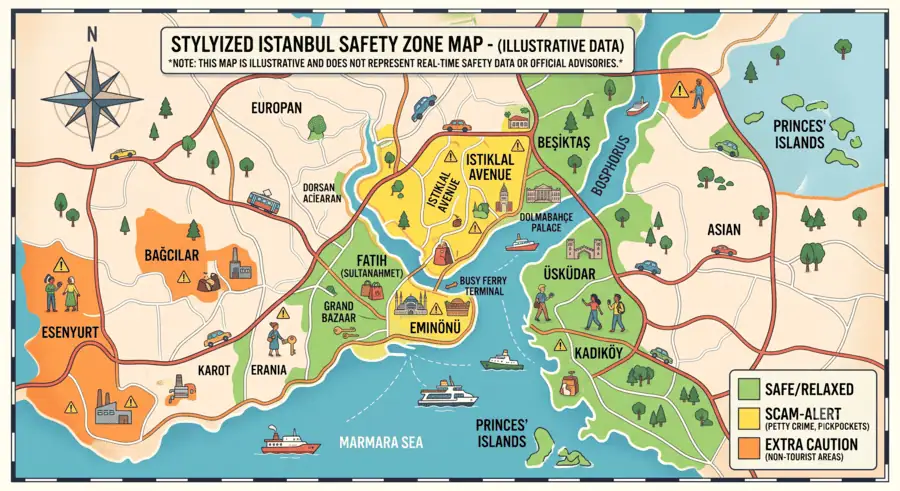
Istanbul doesn’t have a single safety rating — it has a dozen, one for each neighborhood, and they shift depending on the hour. Here’s what to actually expect in the areas you’ll spend time in.
Sultanahmet & the Old City — Tourist Central, Scam Central
This is where the Hagia Sophia, the Blue Mosque, and Topkapı Palace all sit within walking distance of each other, which also makes it the most heavily policed square mile in the city. You’re not going to get mugged here. What you will get is approached — a lot. Sultanahmet has the highest concentration of touts, “off-duty guides,” and carpet-shop conversation-starters anywhere in Istanbul, precisely because it has the highest concentration of first-time visitors.
The mental shift to make: in Sultanahmet, your guard should be up against scams, not violence. Those are different skill sets, and this guide spends a lot more time on the former for exactly that reason.

Beyoğlu, Taksim & İstiklal Avenue — Vibrant but Stay Alert
İstiklal Avenue is Istanbul’s main pedestrian artery — a constant river of people from mid-morning until well past midnight. That volume of foot traffic is itself a safety feature; you’re rarely alone here. But step off the avenue onto one of the narrow side streets, particularly anything drifting toward Tarlabaşı, and the lighting and crowd density both drop fast. Pickpockets work the dense sections of İstiklal itself, especially on weekend nights — that’s a crowd-density problem, not a “this street is dangerous” problem.
Beşiktaş, Ortaköy & Nişantaşı — Istanbul’s Safer, Upscale Side
If you want the version of Istanbul that feels closest to a well-off European neighborhood, this is it. Nişantaşı is the luxury retail district; Beşiktaş is younger, louder, and full of students and football fans; Ortaköy sits right on the Bosphorus with its waterfront mosque and weekend market. All three are well-lit, heavily walked, and about as low-friction as Istanbul gets — the scam density here is noticeably lower simply because it’s not where the tour buses stop.
Kadıköy & the Asian Side — Relaxed, Local & Underrated Safe
Cross the Bosphorus and the whole texture of the city changes. Kadıköy draws a mostly local and expat crowd rather than first-time tourists, and that shift matters: the entire economy of street scams depends on a steady flow of visitors who don’t know the going rate for anything. Kadıköy doesn’t have that flow, so the scam culture that defines Sultanahmet barely exists here. It’s consistently cited as one of the most comfortable neighborhoods in the city to walk, eat, and sit in a café alone, day or night.
Fatih & Eminönü — Conservative, Crowded & Worth Understanding
Eminönü itself is a transit and market hub — ferry docks, the Spice Bazaar, dense crowds, and correspondingly dense pickpocket activity (more on that in the next section). Push further into Fatih, past the main sightseeing corridor, and you’re in one of Istanbul’s most religiously conservative districts. Nothing dangerous happens here, but the social norms shift: revealing clothing draws stares and occasionally comments, particularly for women traveling alone. Dressing a notch more modestly if you’re exploring this area isn’t about safety so much as not standing out more than you already will.
Neighborhoods to Approach With Extra Awareness
Two names come up repeatedly, for different reasons:
- Tarlabaşı, immediately behind İstiklal Avenue, has been the subject of an unfinished, decades-long redevelopment project. It’s still associated with drug activity and reported muggings after dark. There’s genuinely nothing here for a tourist to see — walking through isn’t “authentic,” it’s just unnecessary risk once the sun goes down.
- Aksaray and Laleli, near each other in Fatih, are less about danger and more about discomfort. Laleli is Istanbul’s wholesale shuttle-trade district — leather goods, textiles, and counterfeit designer items sold in bulk to buyers from Eastern Europe and Central Asia — and it has a known red-light element after dark. Aksaray is a dense transit interchange with a conservative residential population. Neither is a place you’re likely to end up unless you’re specifically shopping wholesale or connecting through the metro, and neither rewards a late-night wander.
None of this should read as “avoid entire districts of the city.” It reads as: know what a neighborhood actually is before you wander into it after midnight looking for an “authentic” side street. Istanbul rewards curiosity almost everywhere else.
Tourist Mistakes That Create Problems in Istanbul
Most travel problems in Istanbul don’t begin with crime, scams, or emergencies.
They begin with small mistakes.
A visitor wears the wrong shoes.
Someone follows a Google Maps shortcut through an unfamiliar area.
A traveler books a hotel without realizing it’s at the top of a steep hill.
Another boards a tram during rush hour with luggage and no idea what awaits.
The good news?
Almost all of these situations are easy to avoid once you understand how the city works.
Here are the mistakes first-time visitors make most often – and how to avoid them.
MISTAKE #1
Underestimating Istanbul’s Hills
This is one of the biggest visitor mistakes.
Mistake #1: Assuming Istanbul Is Flat
On a map, Istanbul often looks surprisingly compact.
In reality, it is built across a series of steep hills overlooking the Bosphorus and the Golden Horn.
Many first-time visitors plan ambitious walking routes only to discover that a “10-minute walk” includes:
- steep inclines
- long staircases
- uneven cobblestones
- crowded sidewalks
The route between Karaköy and Galata Tower, for example, is much steeper than many travelers expect.
Likewise, parts of Balat, Cihangir, and Beyoğlu can feel surprisingly demanding during summer heat.
Comfortable walking shoes are not optional in Istanbul.
They’re essential.
MISTAKE #2
Trusting Google Maps Too Much
A fantastic addition that very few competitors mention.
Mistake #2: Following Google Maps Without Looking Around
Google Maps works well in Istanbul.
Until it doesn’t.
The app occasionally prioritizes the shortest route rather than the most practical one.
That can lead visitors through:
- steep staircases
- poorly lit shortcuts
- construction zones
- quiet residential streets
Before blindly following directions, take a moment to look around.
Sometimes a slightly longer route along a busy avenue is more comfortable, safer, and significantly easier to navigate.
Local judgment often beats algorithmic efficiency.
MISTAKE #3
Carrying Too Much Cash
Very important for modern travelers.
Mistake #3: Carrying More Cash Than You Need
Many visitors arrive expecting a cash-based economy.
Modern Istanbul isn’t like that.
Credit and debit cards are accepted almost everywhere, including:
- cafés
- restaurants
- supermarkets
- pharmacies
- museums
- ferries
Keeping a small amount of cash for markets, tips, and occasional purchases is sensible.
Walking around with large amounts of cash, however, creates unnecessary risk and inconvenience.
For most travelers, a modest amount of Turkish Lira plus a bank card is sufficient for daily use.
MISTAKE #4
Trying To See Too Much In One Day
Very strong E-E-A-T addition.
Mistake #4: Treating Istanbul Like a Checklist
One of the fastest ways to ruin a trip is trying to see everything.
Istanbul rewards slowing down.
Many visitors attempt to combine:
- Hagia Sophia
- Blue Mosque
- Grand Bazaar
- Galata Tower
- Bosphorus Cruise
- Kadıköy
into a single day.
Technically possible?
Maybe.
Enjoyable?
Probably not.
Some of the city’s best moments happen when you’re not rushing between landmarks:
- watching ferries cross the Bosphorus
- lingering over Turkish breakfast
- exploring a neighborhood without a plan
- sitting at a waterfront café
Leave room for spontaneity.
MISTAKE #5
Ignoring Rush Hour
Massively underrated advice.
Mistake #5: Using Public Transport During Rush Hour With Luggage
Public transportation is excellent in Istanbul.
During rush hour, however, it can become extremely crowded.
Particularly busy periods include:
- Weekdays: 07:00–09:30
- Weekdays: 17:00–20:00
Trying to board:
- Marmaray
- Metrobus
- Metro
- T1 Tram
with multiple suitcases during these times can be stressful.
If possible, schedule airport transfers, hotel changes, and major journeys outside peak commuting hours.
MISTAKE #6
Staying Too Far From Public Transport
A surprisingly common problem.
Mistake #6: Choosing a Hotel Based Only on Price
A cheaper hotel isn’t always better value.
Saving €20 per night means little if you spend hours climbing hills or paying for taxis.
When booking accommodation, look beyond the room itself.
Check walking distance to:
- metro stations
- tram stops
- ferry terminals
- bus routes
A centrally located hotel often saves both time and energy throughout your trip.
MISTAKE #7
Eating At The First Restaurant Beside A Landmark
Excellent local advice.
Mistake #7: Eating at the First Restaurant Next to a Major Attraction
Restaurants directly beside major landmarks often rely on location rather than quality.
This doesn’t mean they’re bad.
It simply means better options frequently exist a few streets away.
This is particularly true around:
- Sultanahmet
- Galata Tower
- Taksim Square
Walking five minutes away from the busiest tourist zone often results in:
- better food
- better prices
- more local customers
- a more authentic atmosphere
How to Look Less Like a First-Time Visitor
You don’t need to pretend you’re a local.
But a few simple habits can help you move through the city more confidently.
- Stand aside before checking maps.
- Keep phones and wallets secure in crowded areas.
- Learn a few Turkish words.
- Have a rough transport plan before leaving your hotel.
- Walk with purpose, even when unsure.
Perhaps most importantly:
Don’t stop abruptly in the middle of busy sidewalks.
In places like Eminönü, Karaköy, and Istiklal Avenue, pedestrian traffic moves surprisingly fast.
A little awareness goes a long way.
Useful Apps Before You Arrive
A few free apps can make navigating Istanbul significantly easier.
Consider downloading:
- BiTaksi (official taxi booking)
- Uber
- Google Maps offline maps
- Google Translate (Turkish language pack)
- Moovit (public transport planning)
- Istanbul Senin (municipal city services)
Having offline access to maps and key information can be surprisingly helpful if your mobile connection becomes unreliable.
Petty Crime & Street Safety in Istanbul
Pickpocketing — Where, When & How It Happens
Here’s the thing about pickpocketing in Istanbul: it’s not random. It’s a crowd-density problem with a predictable geography, which means it’s also predictably avoidable once you know where the density spikes.
The reliable hotspots:
- The Grand Bazaar and Spice Bazaar — dense, slow-moving crowds in narrow covered lanes
- The T1 tram, especially around midday and at the doors during boarding
- İstiklal Avenue and Taksim Square, particularly on weekend evenings
- Turnstiles, escalators, and ferry docks around Eminönü, where a moment of forced slowdown creates opportunity
Notice the pattern: every single one of these is a place where you’re physically packed in and can’t easily move. That’s not a coincidence — it’s the entire mechanism.
How Pickpocket Teams Actually Operate
Pickpockets in Istanbul very rarely work alone, and understanding the choreography is the best defense you have. The standard setup involves two people: one creates a moment of friction — dropping an object near you, bumping into you at a tram door, blocking a narrow bazaar aisle — while a second person uses that half-second of distraction to open a bag or lift a phone. The “drop” is the tell. If someone drops something directly in your path in a crowded spot and looks to you rather than picking it up themselves, that’s your cue to create distance, not to help.
How to Protect Your Valuables Like a Pro
The fixes here are boring, which is exactly why they work:
- Never keep your phone or wallet in a back pocket
- Wear backpacks on your front, not your back, when the crowd tightens — on the T1, in the bazaars, at ferry boarding
- Use a cross-body bag with a sturdy zipper, and keep a hand resting over it in dense crowds
- Leave your passport in the hotel safe; carry a photo of it on your phone or a photocopy instead
None of this requires paranoia. It requires doing it consistently in the four or five specific situations above, and relaxing everywhere else.
Bag Snatching & Opportunistic Theft
Drive-by bag snatching — someone on a scooter grabbing a bag and speeding off — is genuinely rare in Istanbul, unlike in some other major cities where it’s a defining risk. What actually happens is much more mundane: a phone left face-up on a café table by the sidewalk, a purse hung on the back of a chair in a busy restaurant. Keep your things in your lap or your line of sight and this entire category of risk disappears.
Night Safety — Walking Istanbul After Dark
[IMAGE PLACEHOLDER: Well-lit street in Kadıköy or Beşiktaş at night, cafés and pedestrians visible]
Istanbul genuinely doesn’t sleep early. Walking through Kadıköy, Beşiktaş, or the main stretch of Beyoğlu at 2 a.m. is completely normal — you’ll have plenty of company. The rule that actually matters here is simple: stick to streets with open businesses and foot traffic. The moment a street goes dark and empty, that’s your signal to backtrack to a parallel avenue rather than push through — not because something bad is guaranteed to happen, but because there’s no upside to testing it.
Transport Safety — Metros, Trams & Buses at Night
Public transit stays genuinely safe late into the night. Stations are brightly lit, camera-covered, and staffed. If you’re riding a late-night bus or the Metrobüs after most other passengers have thinned out, sit near the driver or in the most populated section of the carriage rather than an empty end. It’s a small habit that costs nothing and removes any awkwardness of being alone in an empty carriage.
The Istanbul Scam Bible — Every Trick You Need to Know
Nearly every scam on this list shares one mechanic: someone manufactures a small, ordinary-feeling moment of obligation, then cashes it in. Once you can see that pattern, the individual scams stop being scary and start being obvious.
The Shoe Shine Scam — Istanbul’s Most Famous Con
How it works: A man carrying a shoe-shine kit walks ahead of you and “accidentally” drops a brush — usually along the Galata Bridge or İstiklal Avenue, where slow-walking tourists are easy to spot. Picking it up and handing it back triggers an overly grateful reaction and an offer to shine your shoes for free, as thanks. Once he’s finished, the fee suddenly appears — commonly cited in the 200–500 lira range — and if you resist, “friends” tend to materialize nearby.
How to decline without confrontation: If a brush drops in front of you, don’t pick it up — keep walking. If someone offers a free shine outright, a firm “Hayır, teşekkürler” (“No thank you”) without breaking stride ends it every time. This one only works if you engage with it.
The Friendly Local Invitation Scam
This is the one that catches smart, cautious travelers, because it’s built in two stages rather than one.
Stage one — the icebreaker: A well-dressed, fluent-English-speaking stranger strikes up a conversation near Taksim Square or İstiklal Avenue. The opening lines are often specific and rehearsed — a profession (engineer is common), a detail about family, something that makes the encounter feel personal rather than transactional.
Stage two — the switch: He suggests a drink, often at a normal, fairly-priced bar first. You relax — the bill was reasonable, this seems legitimate. Then comes the second suggestion: a “better,” more local spot nearby. This is the actual scam venue. Once you’re seated, drinks arrive unordered, women join the table, and the eventual bill can run anywhere from a few hundred dollars to reports of several thousand — sometimes tens of thousands of lira for what looked like a handful of drinks. Bouncers may physically block the exit and escort you to an ATM if you can’t pay on the spot.
The rule that actually works: Never let a stranger choose your second venue. If a new acquaintance suggests moving somewhere else, counter with a bar of your own choosing — a scammer will drop the pitch immediately rather than follow you somewhere they don’t control.
The Tea Invitation That Costs a Fortune
A milder, non-threatening cousin of the above: a friendly local invites you into a shop for “traditional apple tea,” framed as wanting to practice English. Once you’re seated, it becomes a long, high-pressure sales pitch for carpets, leather, or jewelry. Nobody’s going to intimidate you here — the tea is often genuinely free — but budget twenty minutes you didn’t plan to spend, and know that “no” is a complete sentence.
Taxi Scams — The Full Playbook
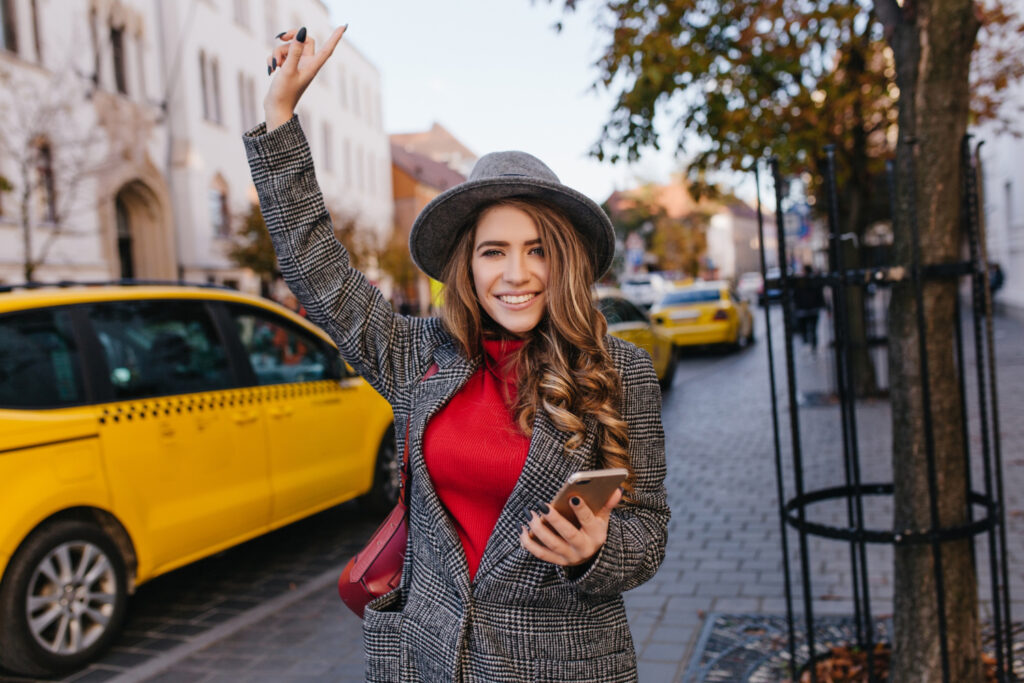
- The long route trick: A driver who clocks you as a tourist takes an unnecessary detour to run up the meter. Keep your route open on Google Maps, visible, with the driver able to see it — this alone removes most of the incentive.
- The broken meter excuse: The driver claims the taksimetre is broken and quotes a high flat fee instead. It’s illegal for a licensed taxi to operate without the meter running — if it doesn’t go on, get out and take another cab.
- The day/night rate switch: Istanbul taxi meters run a day rate (gündüz) and a higher night rate (gece), which only legally applies from midnight to 6 a.m. Some drivers leave the night rate running during the day. Glance at the meter display when you get in — if it says gece in daylight, point at it and ask for the correct rate before the car moves.
- Fake note switching: You hand over a 200 lira note; the driver palms it, produces a 20 lira note instead, and insists you underpaid. State the denomination out loud as you hand it over — “iki yüz lira” (“two hundred lira”) — and hand bills over one at a time rather than as a folded stack.
How to take taxis safely: Use BiTaksi or Uber whenever possible — note that BiTaksi sometimes requires a Turkish phone number to register, which can be a snag if you’re on an international eSIM with no local number, so it’s worth setting up before you land if you can. In Istanbul, Uber doesn’t dispatch private drivers — it books the same licensed yellow and turquoise taxis, just with GPS tracking, an upfront fare estimate, and a digital record of the trip layered on top. If you do hail off the street, confirm the meter is running before the car moves and sit in the back seat.
The Fake Tour Guide & Carpet Shop Pipeline
Someone presenting themselves as an “off-duty guide” offers to show you a shortcut or a hidden detail near Hagia Sophia. The shortcut reliably leads to a carpet shop. A simple, firm “No, thank you” is enough; if they persist, disengage completely rather than negotiating — in Turkish culture, a firm boundary reads as final, not as an opening bid.
Currency Exchange Scams
- Short-changing at the counter: Sleight-of-hand folds bills under the stack handed back to you. Count your money slowly, visibly, in front of the teller, before you step away from the window.
- The too-good-to-be-true rate: A street tout offers a rate noticeably better than the official boards. It’s a trap — expect short-changing, counterfeit notes, or a hidden “tax” appearing mid-transaction. Stick to bank-affiliated exchange offices (döviz bürosu) with posted rates.
Counterfeit Goods & Fake Ticket Scams
The Grand Bazaar is full of “genuine fake” designer goods — buying them is a harmless souvenir choice, just don’t pay authentic prices for them. Separately, never buy museum passes or Bosphorus tour tickets from someone on the street; use official kiosks or the Müze e-ticket system, since street-sold tickets are a documented route for straightforward fraud, not just overcharging.
Online & App-Based Scams
Fake Wi-Fi networks in tourist-dense areas can attempt to harvest passwords — stick to your hotel’s verified network or a local SIM/eSIM for anything involving logins. And be cautious meeting dating-app matches at a bar they choose rather than one you pick — it’s become a modern funnel into the same nightclub overcharge scam described above, just with a different opening move.
What To Do If Something Goes Wrong
Filing a Police Report — The Right Order of Operations
For theft, scams, or lost belongings, go to the Tourist Police first, not your consulate. Istanbul has a dedicated Tourist Police unit (Turizm Polisi) specifically for handling these situations, with English-speaking officers and a straightforward process. The most central office sits on Yerebatan Caddesi in Sultanahmet, right next to the Basilica Cistern entrance, across from the Sultanahmet tram stop — just walk in.
Get a written copy of your police report before you leave. You’ll need it for two things: any travel insurance claim, and — critically — as a required document if you’re applying for an emergency passport at your consulate.
Lost or Stolen Passport
The sequence matters:
- File a police report at the Tourist Police or nearest station within 24 hours of discovering the loss.
- Contact your consulate (not embassy — the Istanbul Consulate General handles citizen services; embassies sit in Ankara) to schedule an emergency travel document appointment. You’ll typically need the police report, proof of identity (even a photo of your lost passport helps), and to appear in person.
- Bring backup ID if you have any — a driver’s license, a printed copy of your passport’s photo page saved before your trip.
This is exactly why keeping a digital photo or photocopy of your passport separate from the physical document, mentioned back in Section 3, matters — it meaningfully speeds up this whole process.
Lost or Stolen Cards & Money
Call your bank or card issuer’s international collect/emergency line immediately — most major banks and card networks operate 24/7 lines specifically for this. Follow up with the Tourist Police report if the loss involved theft rather than simple misplacement, since you may need it for a fraud dispute with your bank.
Medical Emergencies
Refer back to Section 7: dial 112 first, always — before contacting anyone else, including your consulate or insurance provider. Once you’re safe and receiving care, then loop in your travel insurance’s emergency line and, if needed, your consulate.
Contacting Your Consulate — What They Can and Can’t Do
Consulates are for serious, specific situations: a lost passport, an arrest or detention, being the victim of a serious crime, or a medical emergency requiring family contact. What they generally can’t do: pay your bills, give you a loan, act as your interpreter for routine police matters, or intervene in a straightforward taxi dispute or minor scam — that’s what the Tourist Police are for.
Your Istanbul Safety Checklist
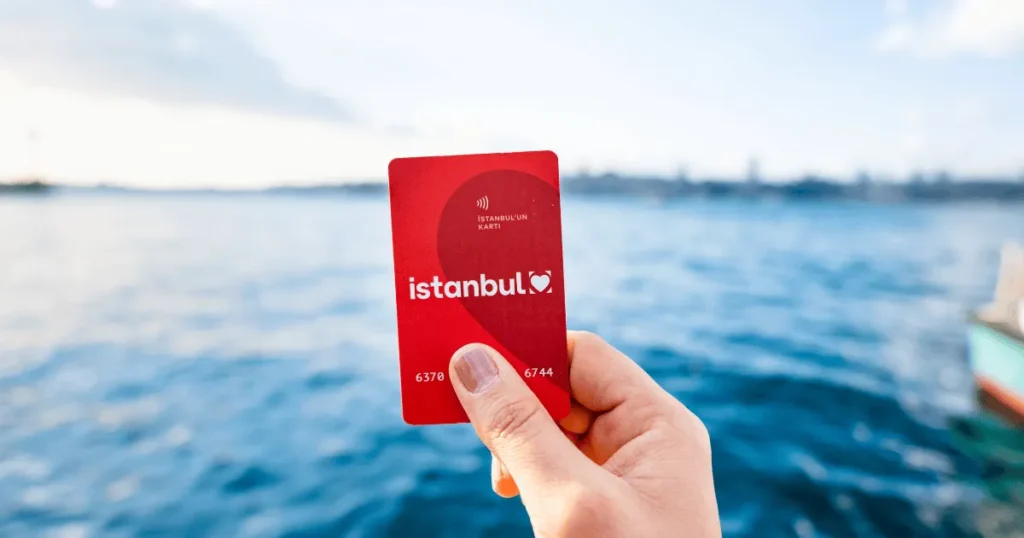
Before You Go
- Buy travel insurance and save the policy number and emergency line on your phone
- Photograph or photocopy your passport’s photo page; store it separately from the original
- Download the AFAD Deprem app for earthquake alerts, and KADES if relevant to you (register early — see Section 8 for the ID caveat)
- Set up BiTaksi if you can register with a local or Turkish number before landing
- Check your accommodation’s construction era if earthquake risk is a genuine concern for you
- If carrying prescription medication, bring it in original packaging with a doctor’s letter
While You’re There
- Keep valuables front-worn in crowds — Grand Bazaar, Spice Bazaar, T1 tram, İstiklal Avenue
- Never let a new acquaintance pick your second bar or venue
- Confirm the taxi meter is running and check it’s not showing gece (night rate) during the day
- Buy museum and tour tickets only from official kiosks or the Müze e-ticket system
- Note your neighborhood’s nearest nöbetçi eczane (duty pharmacy) and emergency assembly point
- Leave drone photography to licensed operators — Istanbul is effectively a no-fly city regardless of drone weight
- Keep 112 saved in your phone; it covers police, fire, and ambulance in one number
If Something Goes Wrong
- Tourist Police first (Sultanahmet office, next to the Basilica Cistern) for reports and lost items
- Consulate second, only for passports, arrests, or serious crimes
- 112 immediately for any medical emergency — before calling anyone else
Earthquakes in Istanbul: What Travelers Should Know
It’s impossible to write about safety in Istanbul without mentioning earthquakes.
The city sits near the North Anatolian Fault, one of the most active fault systems in the region. Scientists expect a significant earthquake to occur at some point in the future, although nobody knows exactly when.
For visitors, this information should create awareness—not panic.
Modern hotels, airports, metro systems, shopping centers, and newer residential developments are generally built under modern seismic regulations.
The likelihood of your trip being affected by an earthquake is extremely small, but knowing basic safety procedures is worthwhile.
If shaking occurs:
- Stay calm.
- Drop, Cover, and Hold On.
- Move away from windows.
- Protect your head and neck.
- Do not use elevators.
- Wait until the shaking stops before moving.
If you are outdoors, move away from buildings, walls, signs, and overhead hazards.
The greatest risk usually comes from falling objects rather than the ground movement itself.
Health & Medical Safety in Istanbul
For most travelers, health concerns are minor compared with transport, crowds, and fatigue.
The city’s medical infrastructure is modern, pharmacies are easy to find, and emergency care is widely available.
The most common travel-related issues tend to be:
- dehydration during summer
- fatigue from excessive walking
- minor digestive discomfort
- seasonal colds
- foot and ankle strain from hills and cobblestones
Many visitors spend so much time sightseeing that they underestimate how physically demanding Istanbul can be.
A full day exploring Sultanahmet, Galata, Karaköy, and Kadıköy can easily involve more walking than expected.
Can You Drink Tap Water in Istanbul?
This question generates endless debate.
Municipal water in Istanbul is treated and meets official quality standards.
However, many locals still prefer bottled or filtered water, particularly in older buildings where internal plumbing may vary.
Most travelers choose bottled water simply because it is inexpensive, widely available, and removes uncertainty.
Tap water is generally used without concern for:
- brushing teeth
- showering
- cooking
For drinking, bottled or filtered water remains the most common choice among both visitors and residents.
The Overlooked Risk: Travel Fatigue
Istanbul is one of the world’s most stimulating cities.
That’s also what makes it exhausting.
Many first-time visitors try to maximize every hour:
- early museum visits
- full-day sightseeing
- evening cruises
- late-night dinners
After several days, the combination of crowds, hills, noise, traffic, and constant movement can become overwhelming.
Building a slower day into your itinerary is often one of the smartest travel decisions you can make.
Take a ferry.
Sit by the Bosphorus.
Spend an afternoon in Moda or Bebek.
The city isn’t a race.
Emergency Numbers Every Visitor Should Save
Before exploring the city, save these numbers in your phone.
112
Turkey’s unified emergency number.
Use it for:
- Ambulance
- Police assistance
- Fire emergencies
Operators can often provide support in English, particularly in major cities.
Your Embassy or Consulate
Before arrival, save the contact information for your country’s diplomatic representation in Turkey.
Most consulates serving tourists are located in Istanbul, while embassies are generally based in Ankara.
Your Travel Insurance Hotline
Many travelers forget this one.
Having immediate access to your insurer’s emergency assistance number can save valuable time during a medical emergency.
WHAT TO DO IF SOMETHING GOES WRONG
If Your Phone Is Lost or Stolen
Your smartphone often contains:
- banking apps
- boarding passes
- hotel reservations
- authentication codes
- personal information
If your phone disappears:
- Use device tracking immediately.
- Lock the device remotely.
- Change critical passwords.
- Contact your mobile provider if necessary.
- Inform your bank if financial apps were accessible.
Acting quickly matters far more than where the loss occurred.
If You Lose Your Passport
Losing a passport is stressful, but it is manageable.
The process is usually:
- Report the loss to police.
- Contact your consulate.
- Obtain replacement travel documents.
- Keep digital copies of identification available if possible.
Many travelers who carry printed and digital copies of important documents find the process considerably easier.
If Your Bank Card Stops Working
International cards occasionally fail because of:
- security blocks
- expired travel notifications
- technical issues
- ATM compatibility problems
For that reason, experienced travelers often carry:
- two separate payment cards
- a backup source of funds
- emergency cash
Relying entirely on a single card creates unnecessary risk.
The Istanbul Smart Traveler Checklist
Before leaving your hotel each day:
✓ Carry only the cash you need.
✓ Keep valuables secure in crowded areas.
✓ Carry a charged phone and power bank.
✓ Know how you’ll return to your accommodation.
✓ Have your hotel address saved offline.
✓ Use licensed taxis or trusted ride-hailing apps.
✓ Drink plenty of water during summer.
✓ Dress appropriately for religious sites.
✓ Stay aware without becoming paranoid.
✓ Leave room for unexpected discoveries.
The goal isn’t to avoid every possible problem.
It’s to travel confidently and enjoy the city.
The Bottom Line
Istanbul’s real safety profile doesn’t match the anxious late-night Google searches. The numbers back it up — a Safety Index statistically tied with Rome and ahead of Barcelona and Paris — and the honest risk here isn’t violence, it’s a handful of well-documented scams that lose their power the moment you can see them coming. Know the two-stage bar trick, know the meter tricks, know which neighborhoods reward curiosity and which don’t reward a 2 a.m. wander, and you’re genuinely better prepared than most visitors who fly in.
The one thing worth carrying with you that no checklist fully captures: Istanbul runs on directness. A firm “no, thank you” without breaking stride handles more situations in this city than any amount of pre-trip research — the touts, the tea-shop invitations, the “helpful stranger” near Taksim Square. Everything else in this guide is just detail in service of that one instinct.
Frequently Asked Questions
Is Istanbul safe for tourists in 2026?
Yes. Violent crime targeting visitors is rare, and recent Governor’s Office data shows offenses against individuals continuing to trend downward in early 2026. The realistic risks are scams and petty theft, not physical danger.
What is the biggest scam to watch for in Istanbul?
The two-stage “friendly local” bar scam — a stranger leads you to a normal-priced bar first, then suggests a “better” second venue where the inflated bill actually hits. Never let someone else choose your second stop.
Is tap water safe to drink in Istanbul?
It’s treated and technically safe, but almost everyone, locals included, drinks bottled water instead due to taste and older building pipes.
Do I need to worry about earthquakes as a tourist?
The risk is real and worth five minutes of preparation — know Drop, Cover, Hold On, and know your nearest assembly point — but short-term visitors face a low absolute risk during a typical stay.
Can I fly my drone in Istanbul?
Realistically, no. Even drones under 500g that are exempt from registration are still barred by Istanbul’s overlapping no-fly zones covering airports, the Bosphorus, and historic sites. Book a licensed operator instead.
What’s the one number I actually need to remember?
112. It covers police, fire, and ambulance, works without a SIM card, and has English-speaking operators.
Is Istanbul safe for tourists in 2026?
Yes. Istanbul is generally considered a safe destination for tourists. Most visitors experience no serious safety issues during their trip. The most common problems involve taxi overcharging, tourist scams, or pickpocketing in crowded areas rather than violent crime. Basic big-city awareness is usually enough to stay safe.
Is Istanbul safe at night?
In popular areas such as Sultanahmet, Galata, Karaköy, Beşiktaş, Kadıköy, and along the main sections of Istiklal Avenue, walking at night is generally safe due to the constant presence of locals, tourists, restaurants, and cafés.
As in any major city, avoid isolated streets, poorly lit shortcuts, and unfamiliar neighborhoods late at night.
Is Taksim Square safe for tourists?
Yes. Taksim Square itself is heavily visited and usually busy throughout the day and evening. Most safety concerns involve pickpocketing, aggressive touts, or tourist scams rather than physical danger.
The square is generally safer than some online forums suggest, although visitors should remain aware of their surroundings during large public events or demonstrations.
Which neighborhoods are considered safest for visitors?
Many travelers feel particularly comfortable staying in:
- Sultanahmet
- Galata
- Karaköy
- Beşiktaş
- Kadıköy
- Moda
- Nişantaşı
- Cihangir
- Ortaköy
These neighborhoods combine strong public transport connections, active street life, and a large number of local residents.
Is Kadıköy safer than Sultanahmet?
Not necessarily safer, but different.
Sultanahmet attracts far more tourists and therefore experiences more tourist-focused scams and aggressive sales tactics.
Kadıköy is more local, residential, and relaxed, with fewer tourist-targeted interactions. Many repeat visitors describe Kadıköy as one of the most comfortable districts in the city.
What is the most common tourist scam in Istanbul?
Taxi-related issues remain the most frequently reported problem by visitors.
These can include:
- unnecessary detours
- refusal to use the meter
- inflated fixed prices
- attempts to exploit airport transfers
The classic shoe-shine scam still exists but is much less common than many travel guides suggest.
Is Uber available in Istanbul?
Yes, but Uber operates differently than in many countries.
Most Uber rides are provided by licensed Istanbul taxis rather than private ride-share drivers. Many visitors use Uber or BiTaksi because both apps provide route tracking, fare estimates, and driver information.
What should I do if a taxi refuses to use the meter?
Politely leave the taxi and find another one.
Licensed taxis in Istanbul are required to use the meter for normal city journeys. If a driver refuses before the trip begins, it’s usually best not to continue the conversation.
Using BiTaksi or Uber helps avoid most of these situations.
Is public transportation safe in Istanbul?
Yes. Istanbul’s metro, tram, ferry, Marmaray, and Metrobus systems are widely used by millions of residents every day.
The biggest concern is crowding rather than crime.
During rush hour, keep bags zipped and valuables secure, particularly on:
- T1 Tram
- Metrobus
- Marmaray
- major ferry terminals
Is Istanbul safe for solo female travelers?
Yes. Thousands of women visit Istanbul independently every year without problems.
Some visitors may experience occasional catcalling or persistent attempts at conversation in tourist areas, but serious incidents involving tourists are uncommon.
Choosing well-connected neighborhoods and using the same precautions you would in other major cities is usually sufficient.
What should women wear in Istanbul?
There is no citywide dress code.
In districts such as Nişantaşı, Kadıköy, Beşiktaş, Galata, and Cihangir, visitors wear clothing similar to other large European cities.
When visiting mosques or more conservative neighborhoods, modest clothing is appreciated and often required.
Is Istanbul safe for LGBTQ+ travelers?
Most LGBTQ+ visitors enjoy Istanbul without issues.
The city contains diverse, liberal neighborhoods alongside more conservative districts. While attitudes vary, discretion and awareness of local norms generally lead to a comfortable experience.
Neighborhoods such as Kadıköy, Moda, Cihangir, and parts of Beyoğlu are often considered among the city’s more progressive areas.
Can I drink tap water in Istanbul?
The water is treated and meets official standards, but many residents prefer bottled or filtered water due to concerns about older building plumbing.
Most visitors choose bottled water because it is inexpensive and widely available.
Tap water is commonly used for brushing teeth and showering.
Are credit cards widely accepted in Istanbul?
Yes.
Most restaurants, cafés, supermarkets, hotels, pharmacies, museums, and shops accept major international cards.
It’s still useful to carry a small amount of Turkish Lira for:
- public toilets
- small kiosks
- local markets
- minor purchases
How much cash should I carry in Istanbul?
For most travelers, carrying the equivalent of one day’s spending money is enough.
Modern Istanbul is largely card-friendly, and carrying large amounts of cash offers little advantage.
Is bargaining expected in Istanbul?
Only in certain places.
Bargaining is common in:
- Grand Bazaar
- Spice Bazaar
- carpet shops
- souvenir stalls
It is not expected in:
- shopping malls
- supermarkets
- chain stores
- restaurants
- cafés
Is Istanbul safe during Ramadan?
Yes.
Tourist attractions, hotels, public transport, and most restaurants continue operating normally.
Ramadan can actually be one of the most atmospheric times to visit the city, particularly around sunset when families gather for iftar.
Visitors are not expected to fast, although respectful behavior in conservative areas is appreciated.
What emergency number should tourists know in Turkey?
The most important number is:
112
This is Turkey’s unified emergency number for:
- ambulance services
- police assistance
- fire emergencies
Saving it before your trip is highly recommended.
What should I do if I lose my passport in Istanbul?
If your passport is lost or stolen:
- Report the loss to police.
- Contact your country’s consulate.
- Obtain replacement travel documents.
- Keep copies of important identification whenever possible.
Having digital copies stored securely online can significantly simplify the process.
What is the biggest mistake first-time visitors make in Istanbul?
Trying to do too much.
Many travelers underestimate:
- the city’s size
- steep hills
- travel times
- crowds
- walking distances
Istanbul rewards slower exploration. Some of the best experiences happen away from major landmarks, whether that’s a ferry ride across the Bosphorus, a neighborhood bakery in Beşiktaş, or an afternoon tea break in Kadıköy.
Should tourists be worried about scams in Istanbul?
Not excessively.
Most scams targeting tourists rely on distraction, pressure, or confusion rather than danger. Learning the most common tricks, using trusted transportation options, and maintaining basic situational awareness is usually enough to avoid problems entirely.
The vast majority of visitors leave Istanbul with memories of historic landmarks, Bosphorus sunsets, vibrant neighborhoods, and Turkish hospitality—not scams.