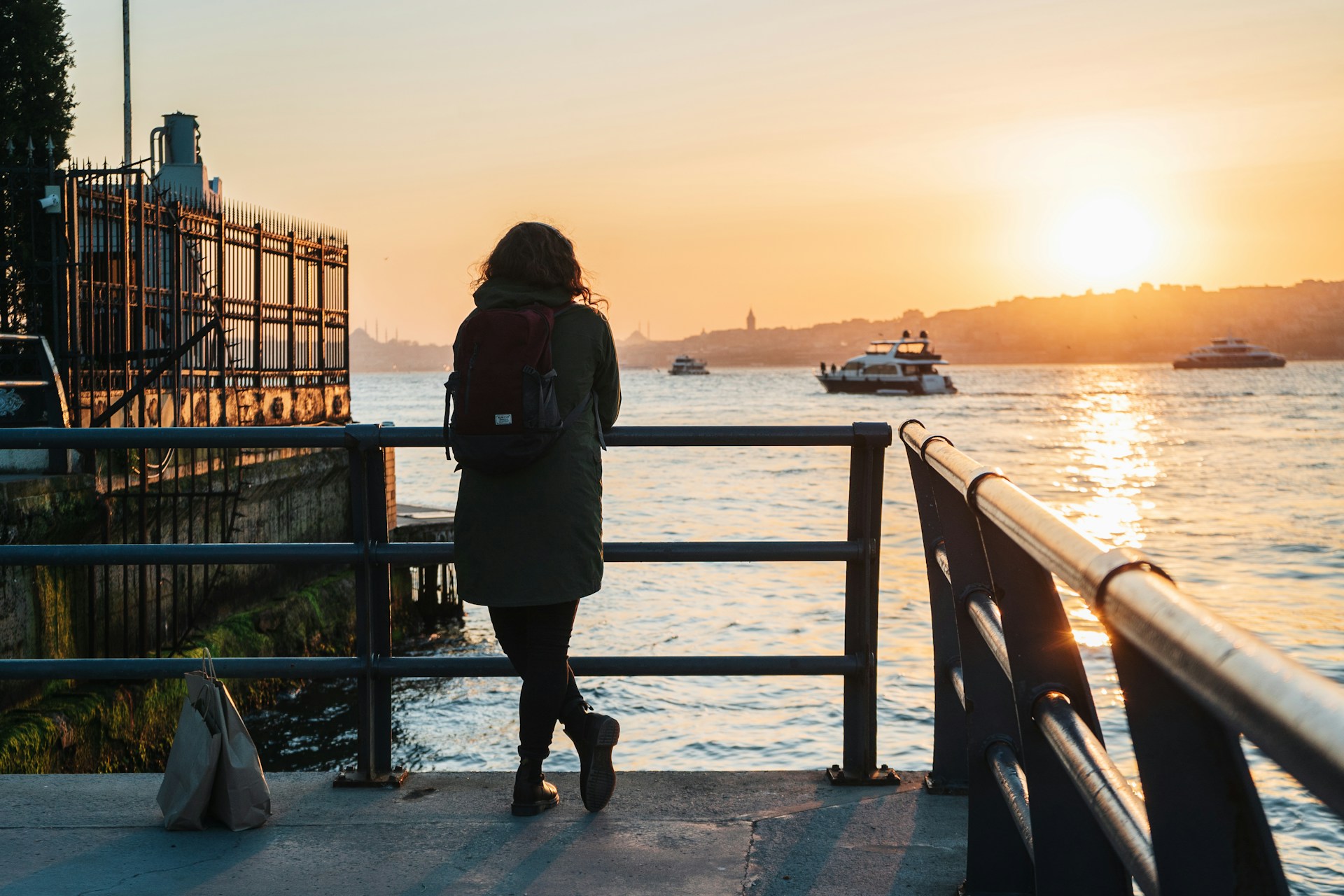
Most cities tolerate women in public space. Istanbul was, for centuries, actively designed around it. The hamam wasn’t just a bathhouse — it was the original women’s social club, one of the only places Ottoman women could legitimately leave the house and gather with people outside their own family. The tea garden wasn’t just somewhere to drink çay — it was where women negotiated, gossiped, and breathed a little easier.
That tradition didn’t vanish with modernization. It evolved. Today it sits alongside wellness studios, sharp nail bars, rooftop wine bars over the Bosphorus, and neighborhood cafés where women can lose an entire Saturday afternoon to a single cup of coffee. Underneath the tourist-facing surface, Istanbul still runs on a social logic built around women’s spaces — and that’s what makes it a genuinely rewarding city to visit as a woman, not just a safe one.
This guide covers the historic hamams and how to navigate them as a female visitor, the modern beauty scene worth your time and money, the social spots where Istanbul’s women actually gather, and the cultural threads that give a female visitor a deeper read on the city.
From Ottoman Hamam to Modern Wellness
The line from a sixteenth-century Ottoman hamam to a 2026 Nişantaşı wellness studio is straighter than you’d think. The philosophy hasn’t moved: women deserve dedicated space for physical care and the kind of conversation that only happens when everyone’s fully relaxed. Marble has given way to bamboo flooring in some spots, and the peştemal now shares space with the spa robe — but the underlying idea, that wellbeing is social and physical at once, runs through both eras unbroken.
Understanding Women’s Social Culture in Istanbul
The Historical Role of Women’s Spaces in Ottoman Istanbul
In Ottoman Istanbul, a woman’s world was largely private — home, family courtyard, and the harem. Public life ran on male terms. But within that, women built a rich parallel social world, and the hamam was its center. The weekly hamam visit was often the one sanctioned occasion for leaving the house socially — women stayed for hours, not minutes, bringing food, musicians, gossip, matchmaking agendas, and sometimes news-carriers paid specifically to move information between households.
The hamam doubled as beauty salon, social club, informal marriage market, and news exchange. Mothers would bring — or scout — prospective daughters-in-law there, a bride-vetting custom that sounds startling now but was simply normal at the time. Engagements, births, and other milestones were marked with dedicated hamam gatherings, food, and music. It was, by most historians’ accounts, one of the most sophisticated female social institutions of its era.
How Turkish Women Socialize Today
Contemporary Istanbul women socialize with a freedom their great-grandmothers couldn’t have imagined. In Beyoğlu and Kadıköy especially, young professional women move through café terraces, wine bars, co-working spaces, and rooftop restaurants without a second thought. Female friendships here run warm and physically close — you’ll see women walking arm in arm everywhere, heads together over a shared phone, talking with the ease of people who’ve known each other since school.
The café, the hamam, and the market remain the three old pillars of female social life. They’ve simply been joined by the yoga studio, the wine bar, the cooking class, and the gallery opening. Istanbul’s female social landscape in 2026 is ancient and completely current at the same time.
Secular vs. Conservative Women’s Social Spaces
Istanbul runs two parallel women’s social worlds at once. In liberal neighborhoods — Cihangir, Kadıköy, Nişantaşı, Beşiktaş — the social spaces look broadly like Milan or Barcelona’s. In more conservative areas — Fatih, Eyüpsultan, pockets of the Asian interior — women’s social life centers more on family gatherings, mosque communities, and gender-separated occasions. Both are real, and both are Istanbul. As a visitor you’ll naturally spend most of your time in the first world, but a respectful, curious glimpse of the second adds real depth to how you understand the city.
The Turkish Hamam — The Complete Women’s Guide
What Is a Hamam and Why It Matters for Women Specifically
A Turkish hamam is part steam bath, part beauty ritual, part social institution, and part living architectural history. For female visitors, it’s something more specific: a space built around women’s needs from the start, where your body is handled with matter-of-fact professionalism, the atmosphere is unhurried, and there’s no male gaze anywhere in the room. It’s genuinely one of the most relaxing things Istanbul offers — and it costs a fraction of a comparable spa day in Western Europe.
How a Traditional Hamam Works, Step by Step
Arrival & the Changing Room (Camekân)
You arrive and are shown to the camekân, the changing room — usually a domed or vaulted space lined with private cubicles. You’re handed a peştemal (a flat woven cotton towel) and often a pair of wooden takunya clogs. Undress in your cubicle, wrap yourself in the peştemal, and lock your valuables away. From here, an attendant (natır) takes over and guides the rest of the visit.
The Hot Room (Hararet) — Heat, Marble & the Navel Stone
The hararet is the heart of the hamam: a domed marble room heated from beneath the floor. At its center sits the göbek taşı, the “navel stone” — a large heated marble platform where you’ll lie for the core of the experience. The heat is dry and intense; smaller marble basins line the walls. Give yourself fifteen to twenty minutes here before any treatment starts — the heat needs time to loosen your muscles and open the skin.
The Kese — Exfoliation Like Nothing Else
This is the part that catches every first-timer off guard. Your attendant puts on a rough kese mitt and works it over your skin in firm strokes. What comes off — grey rolls of dead skin, even if you showered that same morning — is oddly satisfying and a little alarming at once. No home exfoliation comes close. Afterward your skin genuinely feels like it belongs to someone a decade younger.
The Köpük Masajı — Foam Massage
A pillowcase filled with air and soap is pressed and drawn across your body until you’re wrapped in warm foam. The natır then works that foam into a massage — firmer than you’d expect, focused on shoulders, back, and arms. Kese plus foam massage together run about thirty minutes.
Rest, Tea & Cooling Down
You’re walked back to the changing room, wrapped in dry towels, and left to rest — usually with a glass of çay. Don’t rush this part. Your body needs time to bring its temperature back down, and the post-hamam glow needs that settling time to actually land.
Tipping at the Hamam
Tip your natır directly, in cash, at the end. Around 20–30% of the service cost is standard and genuinely matters — attendants rely on tips as real income. Keep small bills ready so you’re not digging through your wallet in a towel.
Types of Hamam Experience Available to Women
- Women-only sessions: the most traditional and comfortable option. Many historic hamams reserve set hours exclusively for women, and the atmosphere runs noticeably more relaxed and less self-conscious than in mixed-gender tourist hours.
- Mixed hamams with separate sections: men and women in entirely different physical areas with same-gender attendants — the separation is complete, not just curtained off.
- Private bookings: several premium historic hamams let you hire the entire women’s section for a group. For a bachelorette party or a birthday, this is exceptional value and one of the best group experiences Istanbul offers.
What to Wear & Bring as a Woman
- Bring a swimsuit if you’d rather not go peştemal-only — both are completely normal, and you’ll decide once you’re in the changing room.
- Leave your phone in the locker. Photography inside a hamam is a hard, universal no — steam, undressed strangers, and the social sanctity of the space make this non-negotiable.
- Wooden takunya are provided, but bring flip-flops if you prefer your own.
- Remove all jewelry before entering the hararet.
- Bring a gentle moisturizer for afterward — your pores will be wide open.
The Best Historic Hamams in Istanbul for Women
Çemberlitaş Hamamı — The Sinan-Designed Classic
Commissioned in 1584 by Nurbanu Sultan and attributed to imperial architect Mimar Sinan, Çemberlitaş is one of the oldest continuously operating hamams in the world, sitting right at the edge of the Grand Bazaar. Men’s and women’s sections run in parallel, each with its own domed hararet under the characteristic Ottoman star-patterned skylight. One correction worth knowing: the women’s section doesn’t have a separate street entrance anymore — 19th-century street works changed that, and today everyone enters through the same main door, then splits off internally. The architecture alone justifies the visit: you’re lying on marble that’s been heated for over four centuries. Services range from a basic kese to full luxury packages, and prices sit mid-range to high given the location and tourist demand. Book online ahead during peak season.
Kılıç Ali Paşa Hamamı — The Beautifully Restored Gem
Built in 1580, also credited to Sinan, and left derelict for decades, Kılıç Ali Paşa reopened in 2012 after a meticulous seven-year restoration — architecture preserved, service brought up to a genuinely high standard. It’s the hamam knowledgeable female visitors tend to love most: more curated, less rushed than the bigger tourist-facing baths, with one of the largest single domes Sinan ever built. Note the schedule, because it’s fixed rather than session-based: women are welcome daily from 8:00am to 4:00pm, men from 4:30pm to 11:30pm. Book ahead — the women’s morning-to-afternoon window fills, especially on weekends. It runs slightly more expensive than Çemberlitaş, and the experience quality reflects that.
Çağaloğlu Hamamı — The Grand Ottoman Bathing Palace
Built in 1741 to fund Sultan Mahmud I’s library at Hagia Sophia, Çağaloğlu was the last great hamam built in the Ottoman era, and it looks it — a striking blend of Ottoman and emerging Baroque style. Its women’s section has its own monumental scale, entered from a side street while the men’s section faces the main road. The guestbook is genuinely historic — Florence Nightingale is among the documented visitors, alongside a long list of celebrities and dignitaries since. For a first hamam experience, Çağaloğlu’s theatrical size makes it memorable, though the high tourist volume makes it feel a touch less intimate than Kılıç Ali Paşa.
Tarihi Galatasaray Hamamı — Beyoğlu’s Historic Bathing House
Founded in 1481 under Sultan Bayezid II as part of the Galatasaray complex, this is one of the oldest hamams in the city and a genuinely convenient option if you’re staying in Beyoğlu — an easy walk from İstiklal Avenue, no trip to Sultanahmet required. The women’s section is well maintained, and because the clientele mixes tourists with actual Istanbul locals, the social energy reads a little more authentic than the purely tourist-facing baths of the old city.
Luxury Hamam Experiences at Istanbul’s Hotels
{Image: marble hammam interior with Bosphorus view, luxury hotel spa}
For travelers whose budget stretches further, several of Istanbul’s grand hotels run hamam facilities at a different level of comfort. The Çırağan Palace Kempinski’s hamam dates to 1874, built inside the Ottoman palace itself and now part of the hotel’s Sanitas Spa — genuinely one of the more remarkable settings in the city. The Four Seasons Bosphorus offers a sleeker, more contemporary take on the same tradition, with hammam rituals across several marble-lined chambers and five-star service throughout. These hotel hamams don’t carry the centuries of patina that the neighborhood originals do, but they trade that for consistency, privacy, and comfort — worth it for travelers who want a special-occasion experience rather than a historical one. Prices run considerably higher than the historic hamams, but for the right occasion, they deliver.
Budget Guide for Women’s Experiences in Istanbul
{Image: simple flat-lay of Turkish lira notes and coins beside a peştemal towel}
Istanbul’s beauty and wellness scene delivers remarkable value at every budget level, though 2026 prices sit meaningfully higher than they did even two or three years ago — the lira’s ongoing depreciation means local prices climb steadily even as the city stays cheap by Western European standards in hard-currency terms.
- Neighborhood hamam (basic kese and foam massage): approximately 700–1,200 lira
- Historic tourist hamams (Çemberlitaş, Kılıç Ali Paşa, Çağaloğlu — full treatment package): approximately 1,500–4,000 lira, depending on venue and package tier
- Blow-dry at a neighborhood salon: approximately 300–600 lira
- Eyebrow threading: approximately 250–400 lira — still one of the city’s best beauty bargains
- Gel manicure at a quality nail studio: approximately 600–1,000 lira
- Premium hotel spa day pass: approximately 2,500–6,000 lira
- Yoga drop-in class: approximately 400–700 lira
Even at these higher 2026 levels, Istanbul remains one of Europe’s best-value beauty and wellness destinations for female visitors, particularly at the mid-range and premium tiers, where the quality-to-price ratio still comfortably beats London, Paris, or New York.
Sample Women’s Itineraries for Istanbul
{Image: sunset view of the Bosphorus from a rooftop terrace}
The Perfect One-Day Women’s Istanbul Experience
Morning: A long Turkish breakfast at a Cihangir café — the full spread, multiple teas, no rush. Late morning: Walk to Sultanahmet for the Topkapı Harem, with enough historical context going in to make it genuinely interesting rather than merely photogenic. Afternoon: A hamam session — book Kılıç Ali Paşa or Çemberlitaş for a 2pm slot and plan two full hours, rest period included. Evening recovery: Wander Karaköy’s design studios and coffee shops while your post-hamam skin glows. Dinner: A meyhane table in Beyoğlu — rakı, mezes, grilled fish, and the unhurried rhythm that makes Turkish dining one of the world’s great social formats. Nightcap: A glass of wine at a Cihangir wine bar, watching the city’s lights reflect off the Bosphorus below.
The Three-Day Women’s Wellness & Culture Itinerary
Day One: Arrive, settle into Beyoğlu or Cihangir accommodation, an evening orientation walk through İstiklal and Karaköy, dinner at a female-friendly lokanta, early night. Day Two: Old city women’s history in the morning — the Topkapı Harem, wider Sultanahmet, lunch by the water in Eminönü — followed by an afternoon hamam session and an evening wine bar in Beyoğlu. Day Three: Ferry to Kadıköy for the Asian side’s female social culture — morning market, a bookshop-café afternoon, lunch at a neighborhood spot — then a sunset ferry back to the European side and a farewell meyhane dinner around a long, shared table.
The Bachelorette Weekend Itinerary
Friday evening: Arrive, dinner at a rooftop restaurant with Bosphorus views, welcome cocktails in Karaköy. Saturday: A private hamam booking (pre-arranged, 2–3 hours) as the day’s anchor, group lunch, afternoon bazaar shopping, pre-dinner cocktails at a Beyoğlu rooftop bar, a long meyhane dinner in Kumkapı. Sunday: A Bosphorus cruise — private boat or public ferry out to the villages — Asian-side brunch in Kadıköy, afternoon shopping in Nişantaşı, and a farewell dinner before everyone heads home.
Conclusion
Istanbul doesn’t just accommodate female visitors — it has spaces, traditions, and a social culture built with women’s needs in its foundations. From the marble and steam of a sixteenth-century hamam to a Kadıköy wine bar on a Friday evening, the city offers female social experiences of real depth. Its architecture carries women’s history in it. Its beauty traditions reward genuine exploration. Its café culture celebrates the long, unhurried gathering of women over food and conversation in a way that, once you’ve experienced it, feels like something every city should offer.
Come for the history, the food, the hamam. Stay for the discovery that underneath its tourist-facing surface, Istanbul has a deep, living women’s culture that genuinely welcomes you into it.
Frequently Asked Questions
Q1: Do I need prior hamam experience before visiting one of Istanbul’s historic hamams?
No — most visitors are first-timers, and the staff are used to guiding newcomers through every stage. Most historic tourist hamams have staff with at least basic English, and the process is intuitive once you’re inside it. The only real preparation worth doing is reading what to expect (which this guide covers), so the kese exfoliation doesn’t catch you off guard, and bringing a little tip cash. Arrive without worrying about how your body “should” look — hamam culture is completely non-judgmental, and the relaxed body confidence you’ll see in the other women there is one of the most liberating parts of the experience.
Q2: What’s the best hamam in Istanbul for a first-time female visitor?
Kılıç Ali Paşa Hamamı in Tophane is the most consistently praised by first-time female visitors — beautiful historic architecture, high service quality, professional female attendants, and a noticeably calmer atmosphere than the Grand Bazaar-area hamams. It’s fixed to specific daily hours (women 8am–4pm), so plan around that. It runs more expensive than Çemberlitaş but delivers a more curated experience. For a more dramatic historic setting at a slightly lower price point, Çemberlitaş is an excellent alternative. Book online in advance for either — both fill up, especially on weekends and during peak season.
Q3: How much should I budget for beauty treatments in Istanbul?
Istanbul still offers excellent value at every budget level, though 2026 prices run higher than a couple of years ago. A neighborhood hamam runs roughly 700–1,200 lira; the historic tourist hamams charge 1,500–4,000 lira for a full package. Eyebrow threading costs around 250–400 lira — still one of the city’s best beauty bargains. A quality manicure runs roughly 600–1,000 lira, and a blow-dry at a mid-range salon costs around 300–600 lira. Premium hotel spa day passes run 2,500–6,000 lira but typically include pool and hamam access plus a treatment. All of this still represents meaningful savings against equivalent services in London, Paris, or New York, at broadly comparable quality.
Q4: Are Istanbul’s cafés genuinely comfortable for women spending long periods alone?
Yes — this is one of the city’s real gifts to solo female travelers. Café culture in Cihangir, Kadıköy, Karaköy, and Beyoğlu completely normalizes women occupying a table alone for hours. You’ll see Turkish women doing exactly that — working, reading, meeting friends, or just sitting — in almost every café in these neighborhoods, with no implicit pressure to keep ordering or free up the table. A single coffee or tea in Cihangir can comfortably stretch to two or three hours without a hint of awkwardness.
Q5: What are the best beauty products to buy and bring home from Istanbul?
A handful of purchases are genuinely worth the suitcase space. Artisan olive oil soap — especially handmade Aegean varieties from specialty shops in Karaköy and the Spice Bazaar — is exceptional and hard to find at home. A genuine peştemal (hamam towel) from a reputable textile shop — look for 100% cotton, hand-woven, tight weave — is both beautiful and genuinely useful. Rose water from Isparta, sold at the Spice Bazaar and specialty food shops, is excellent quality and very affordable. Black seed oil (çörekotu yağı) from a reputable herbal shop is both useful and deeply Turkish. And a proper kese mitt lets you bring the exfoliation ritual home with you. Together, these five items weigh almost nothing and capture the core of Turkish beauty culture in portable, giftable form.