If you’ve spent any time scrolling Istanbul on Instagram, you already know the photo I’m talking about, even if you never learned its name. A single seagull, wings spread mid-flight, frozen in the air with Hagia Sophia’s dome and minarets glowing behind it in the early light. It looks like the bird timed its flight perfectly for the camera. It didn’t. Someone with a plate of bread just out of frame timed it for you.
That photo has a home address. It’s not a metaphor — there is one specific rooftop in Sultanahmet where this shot actually works, and almost every version of it you’ve seen online was taken within about ten meters of the same railing. That terrace belongs to Seven Hills Restaurant, on top of the Seven Hills Hotel in Cankurtaran, and this guide is about why the geometry, the seagulls, and the breakfast all happen to line up in exactly one place.
Key Details
- Location: Situated in the Sultanahmet (Old City) district at Cankurtaran, Tevkifhane Sokak No:8, Fatih/İstanbul.
- Highlights: Famous as an iconic photo spot where guests often take pictures while feeding local seagulls against the backdrop of the historic minarets.
- Offerings: Fresh daily seafood from the Marmara Sea and traditional Turkish cuisine/breakfast.
- Hours: Open daily from roughly 8:30 AM to 11:00 PM (breakfast until 12:00 PM, lunch and dinner from 12:00 PM to 11:00 PM).
- Access: Walk-ins are generally welcome, and it is open year-round.
This article is a part of our big Istanbul Rooftop Guide: Best Bars & Restaurants with Views.
What the “Seagull Photo” Actually Is (And Why It’s Not Luck)
Walk along almost any rooftop in the Sultanahmet area and you’ll get a decent view of Hagia Sophia. What you won’t get, on most of them, is a seagull flying between you and the dome, close enough to fill the frame, at eye level, without a crane or a zoom lens that flattens the whole scene into a blur.
The trick isn’t a lucky bird. It’s a feeding ritual that’s been going on at Seven Hills for years — a staff member (or a guest who’s been let in on the habit) tosses small pieces of bread from the terrace, and the local gulls, who clearly know the routine, swoop in low and close. Because the terrace sits at a height and angle where Hagia Sophia fills the background without you needing a wide-angle lens, a well-timed toss puts a gull mid-wingspan directly in front of the dome. That’s the whole trick. It’s not complicated, but it is specific to this exact terrace, which is why you don’t see the same photo taken from ten other rooftops nearby.
Why Seven Hills Owns This Shot and Almost Nobody Else Does
The Geometry That Makes It Work
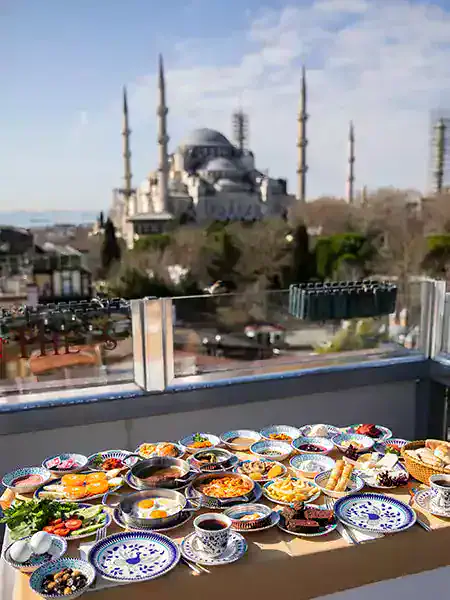
Seven Hills sits in Cankurtaran, on the section of the old city walls between Hagia Sophia and the Sea of Marmara. That position matters more than the height of the building. The terrace looks almost directly across at Hagia Sophia’s eastern side, with the Blue Mosque visible off to one side and the Marmara Sea and Princes’ Islands behind you. Because you’re looking across rather than down, the dome sits roughly at your eye level instead of shrinking below you the way it does from taller, more distant rooftops in Beyoğlu or Galata. That’s the difference between a postcard view and a photo where a bird in flight can actually cross in front of the monument instead of disappearing into the rooftops below it.
Most other rooftop bars with a “Hagia Sophia view” are either too far away (so the dome becomes a small shape in the distance) or angled so you’re looking past the building rather than at it. Seven Hills is close enough and aligned well enough that the dome fills a meaningful chunk of the frame even on a standard phone camera, no zoom required.
Who’s Actually Feeding the Seagulls
This part surprises people. It’s not a paid photo service and there’s no sign-up. Staff feed the gulls somewhat informally, mostly in the morning, and guests are usually welcome to grab a bit of bread from their own breakfast table and toss it themselves if a waiter isn’t already doing it. Reviewers have described a staff member on a neighboring rooftop tossing food specifically to draw the birds into frame for guests, which is as close to a “photo service” as it gets. Don’t expect a choreographed session — it’s closer to feeding pigeons in a park that happens to have one of the world’s great domes as a backdrop.
Choose best excursion in Istanbul
One honest caveat: seagulls are wild birds, not trained ones. Some mornings they’re everywhere. Other mornings, especially if it’s windy or the terrace is quiet, you might get one or two passes and that’s it. Nobody can guarantee you the shot, and you should be a little suspicious of anyone who claims they can.
The Breakfast Itself: What You’re Actually Getting
The seagull photo is the hook, but you’re also sitting down for a proper Turkish breakfast, and it’s worth understanding what that means before you go, because it’s not a continental buffet with a nice view.
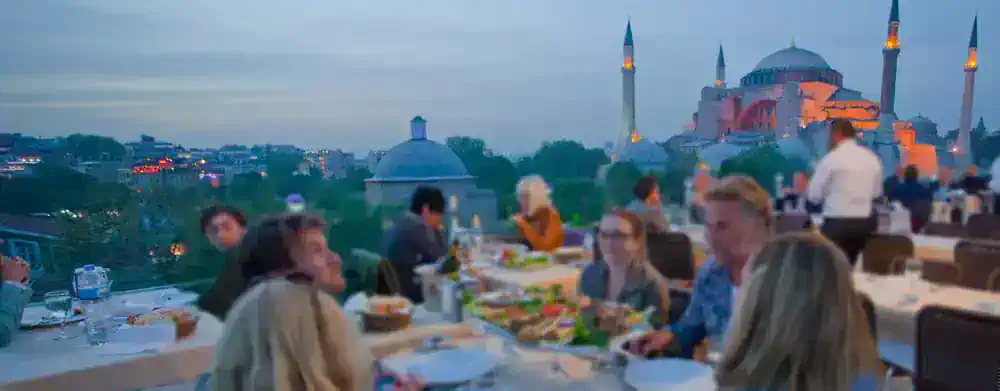
What’s on the Table
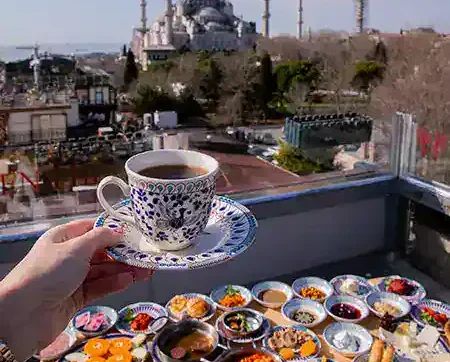
A traditional Turkish breakfast spread (kahvaltı) at a place like this typically arrives as a wide, low table covered in small plates rather than one big dish. Expect a rotating cast of:
- Several kinds of cheese (beyaz peynir, kaşar, and often a few regional varieties)
- Olives, both green and black
- Tomatoes and cucumbers
- Honey with kaymak (clotted cream) — non-negotiable if you’ve never tried it
- Jams, usually including a fruit preserve and sometimes a savory pepper spread
- Eggs, prepared simply
- Fresh bread and simit
- Turkish tea, served in the small tulip-shaped glasses, often with a refill offered
Some reviewers have specifically praised the egg preparation and the overall generosity of the spread for a fairly modest per-person price, especially compared to what you’d pay for a similar view-and-food combination in a more central European capital. Vegetarians are generally well accommodated, since a Turkish breakfast leans heavily on cheese, vegetables, eggs, and bread rather than meat.
Breakfast service typically runs until around noon, after which the menu shifts to an à la carte lunch and dinner focused on seafood pulled from the Marmara Sea, along with grilled meats and mezes. If you’re only coming for the breakfast-and-photo combination, aim to arrive well before that cutoff — not just for the food, but because the light and the birds both behave differently later in the day.
Best Time to Go for Light and Birds
This is where expertise actually changes your outcome, and it’s the part most generic guides skip entirely.
Morning light hits Hagia Sophia’s western and southern faces first, which is roughly what you’re looking at from this terrace, so an early breakfast slot gives you a warmer, more even light on the dome than midday sun, which tends to wash everything out and create harsh shadows. Seagulls also seem to be more active early — likely because that’s when the terrace is quieter and staff are setting up, tossing scraps as they go.
If photography is your main goal rather than a relaxed brunch, aim for the first hour or two after opening, on a weekday if you can manage it. Weekend mornings bring larger groups, and the terrace fills with tables, which means less patience from staff for casual bread-tossing and more competition for a window-side seat.
Common Mistakes People Make (And How to Avoid Them)
Booking Mistakes
A lot of visitors show up without a reservation expecting to walk into a window table, and are then disappointed. Window and terrace-edge seating — the seats that actually give you a clean sightline for the photo — go first, and staff have been known to reseat people when a reserved party arrives even if you’re already sitting there. If the shot matters to you, reserve ahead and specifically request a terrace or window table when you book, not just “a table with a view.” Confirm it again when you check in, since availability can shift.
Stay connected during your trip
Camera and Timing Mistakes
The most common photography mistake is trying to zoom in tight on the bird. A closer, wider frame that includes both the gull and a generous slice of Hagia Sophia almost always looks better than a cropped shot that loses the context. Burst mode or a phone’s equivalent (holding the shutter button) is genuinely useful here, because gulls move fast and unpredictably — you’re not going to nail the composition on a single manually-timed tap.
It also helps to pick your background before the bird shows up. Frame Hagia Sophia the way you want it, hold reasonably still, and wait for a gull to cross into that frame, rather than chasing individual birds around the sky with your camera.
Feeding Technique Mistakes
Throwing a huge handful of bread at once tends to scatter the birds rather than draw a single one in close. Small, steady tosses — a bit at a time — keep gulls circling back for repeated passes instead of causing a chaotic scrum that’s harder to photograph cleanly. And be mindful of your neighbors: not everyone at the next table wants bread crumbs flying past their coffee.
The Honest Pros and Cons
No credible guide pretends a popular tourist-facing rooftop is flawless, and Seven Hills genuinely isn’t. Here’s the balanced picture based on what guests consistently report.
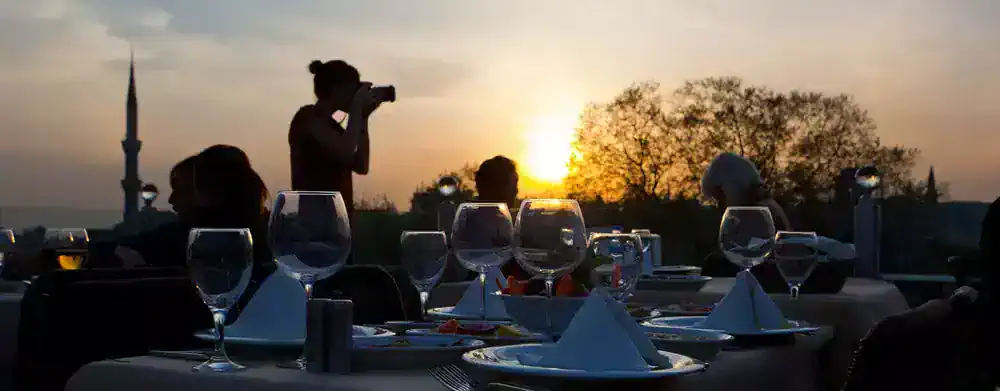
What Works in Its Favor
- The view is legitimately rare. Very few dining spots in the old city let you see Hagia Sophia and the Blue Mosque simultaneously, at a height that keeps both landmarks visually prominent rather than distant.
- The breakfast is generous for the price, particularly compared to hotel breakfasts elsewhere in the historic peninsula.
- The seagull photo opportunity is genuinely unique to this terrace, not marketing spin — the combination of height, angle, and an established feeding habit isn’t easily replicated elsewhere.
- Service has been described as warm and attentive by many guests, with staff going out of their way to offer tea or help with seating.
What to Watch Out For
- Pricing is inconsistent and, by multiple accounts, steep for what’s delivered outside the set breakfast menu. À la carte seafood and drinks in particular have drawn repeated complaints about being expensive relative to portion size.
- Service quality seems to vary by table size and time of day. Several reviewers, particularly those dining as couples rather than large groups, have described feeling rushed or deprioritized.
- The seagulls leave a mess. Feeding birds on a rooftop terrace means occasional droppings nearby — a fair trade for most people chasing the photo, but worth knowing if it bothers you.
- It is, undeniably, a tourist-oriented venue, and some visitors feel that shows in both pricing and the occasional impersonal service, especially during busy periods.
None of this means skip it. It means go in with realistic expectations: you’re paying for a view and a moment, not necessarily a top-tier culinary experience.
Pricing Reality (So You’re Not Surprised)
Set breakfast menus have been reported in the rough range of 600–800 Turkish lira per person, though menu prices in Istanbul move quickly with currency shifts and seasonal changes, so treat any specific number as a snapshot rather than a guarantee — check current pricing when you book. Individual à la carte dishes and drinks tend to cost more, and this is where most of the “overpriced” complaints originate, particularly around seafood priced by weight and specialty cocktails. If your main goal is the breakfast-and-photo combination, ordering from the set breakfast menu rather than à la carte is generally the better value, and it’s also the version of the meal most consistently praised in reviews.
A practical tip: if you’re staying at the Seven Hills Hotel itself, breakfast access to this terrace is typically included in your room rate, which effectively gives you repeated, unhurried access to the photo opportunity across multiple mornings rather than a single rushed visit.
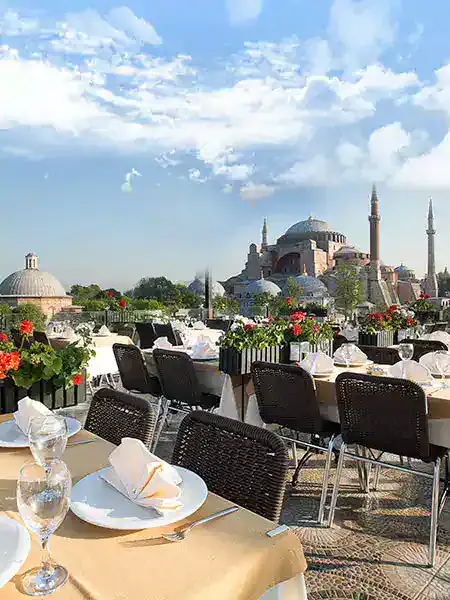
Practical Logistics
- Location: Cankurtaran, Tevkifhane Sokak, in the Fatih district — a short walk from Sultanahmet Square, Hagia Sophia, and the Hippodrome, and about 300 meters from the Marmara Sea shoreline.
- How to get there: Walk from Sultanahmet tram stop (T1 line) — it’s close enough that a taxi rarely makes sense unless you’re coming from further afield.
- Breakfast hours: Generally served until around noon, after which the menu switches to lunch and dinner.
- Reservations: Strongly recommended, especially for a window or terrace-edge table. Book a few days ahead in high season (spring and early autumn tend to be busiest).
- Seating: Ask specifically for terrace seating facing Hagia Sophia when you reserve — indoor seating exists too, but it won’t give you the photo angle.
- Dress and comfort: No particular dress code, but mornings on an open rooftop can be breezy even when the streets below feel warm, so a light layer is worth bringing.
If Seven Hills Is Fully Booked: What Are Your Alternatives?
Worth being honest here — Seven Hills is popular, and if you can’t get a terrace table, a few nearby rooftops offer views of Hagia Sophia from a similar general area, though none replicate the exact eye-level angle and established gull-feeding habit that make the specific “seagull photo” possible. You can still get a strong Hagia Sophia rooftop photo elsewhere in Sultanahmet; you’re less likely to get this particular photo, with a bird frozen mid-flight directly in front of the dome. If that exact shot is your goal, it’s worth planning ahead rather than treating Seven Hills as one option among many.
Conclusion
The “seagull photo” isn’t magic, and it isn’t random — it’s the product of one terrace’s specific height, angle, and a years-long habit of tossing bread to the local gulls, all lined up with one of the best straight-on views of Hagia Sophia in the old city. Seven Hills won’t give you the cheapest breakfast in Sultanahmet, and depending on the morning, it might not even give you a perfect bird photo. But it’s the one place in Istanbul where that combination of a real Turkish breakfast, a genuinely rare skyline view, and a shot at that specific photo all exist in the same forty-five minutes. Book ahead, ask for the terrace, order from the set breakfast menu, and bring a little patience for the birds — they show up on their own schedule, not yours.