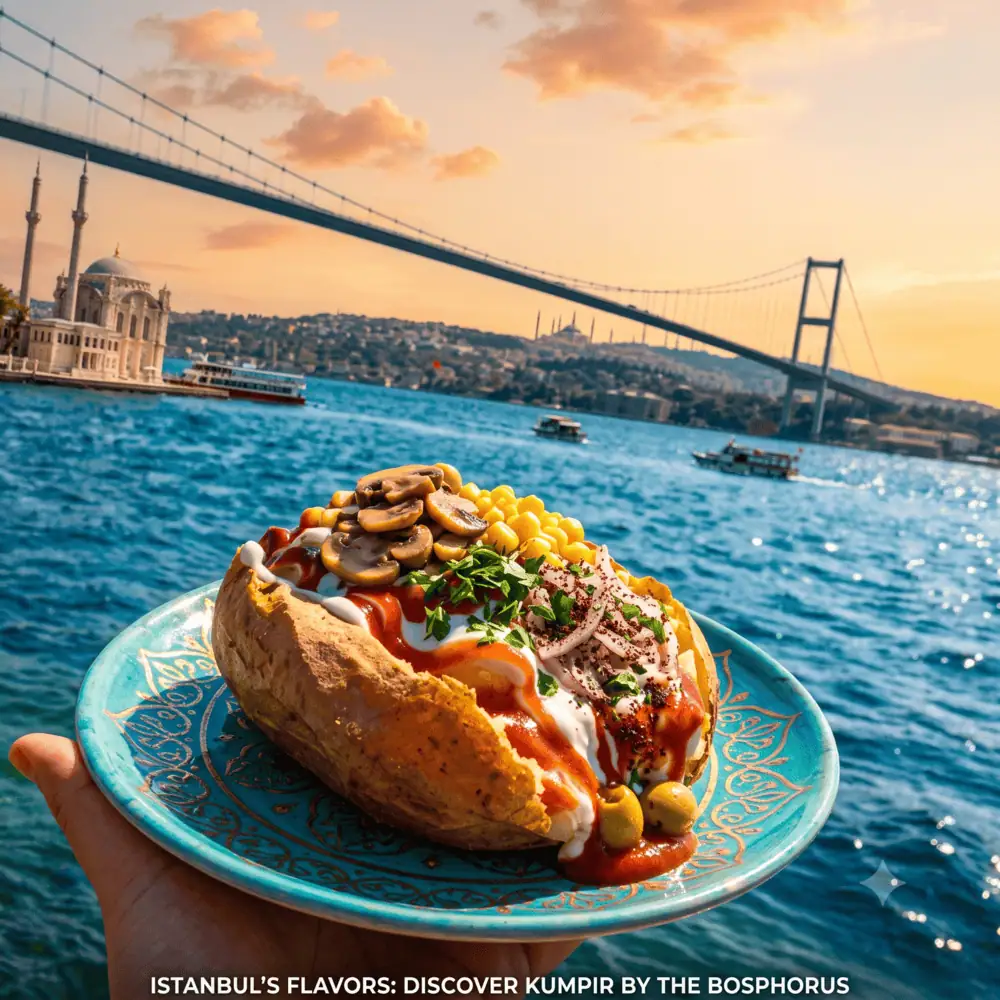
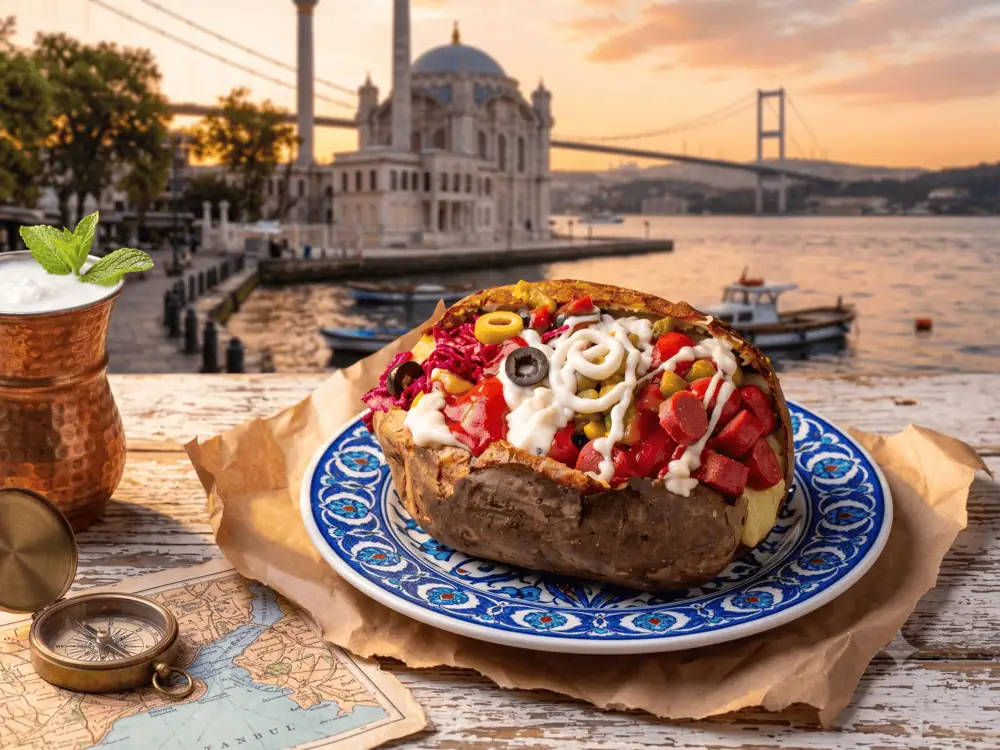
Picture a potato the size of your forearm, split open, mashed to a cream with butter and melting cheese, then buried under twenty bowls of toppings you’d never think to put anywhere near a potato. That’s kumpir, and in Istanbul it has exactly one spiritual home: the waterfront strip in Ortaköy, right under the shadow of the Bosphorus Bridge.
Here’s the thing nobody tells you before you walk up to that counter: ordering kumpir isn’t as simple as “give me one of everything.” There’s a rhythm to it, an order operations happen in, and a handful of combinations that locals actually eat versus the ones that just look good in a tourist’s photo. Get it wrong and you end up with a soggy, flavor-clashing mess. Get it right and you understand why Istanbulites have been queuing for this thing for decades.
This guide walks you through the entire process — how the stands actually work, which toppings belong together, which combos are rookie mistakes, and what you should honestly expect to pay in 2026. No fluff, no invented “I discovered this hidden gem” nonsense. Just the mechanics of the dish, laid out clearly.
This is a part of Turkish Food Guide: Traditional Dishes & Eat Like a Local
What Kumpir Actually Is (It’s Not Just a Baked Potato)
Calling kumpir a “loaded baked potato” undersells it the way calling a döner a “meat sandwich” undersells döner. The base is a genuinely oversized potato — vendors bake these things until the skin crisps and the inside turns almost cloud-like. Once it’s ready, it gets sliced open and worked with a fork right in front of you: a generous knob of butter and a good amount of kaşar cheese (a mild, stretchy Turkish yellow cheese) get mashed directly into the flesh until the whole thing turns into a rich, almost mousse-like base.
Choose best excursion in Istanbul
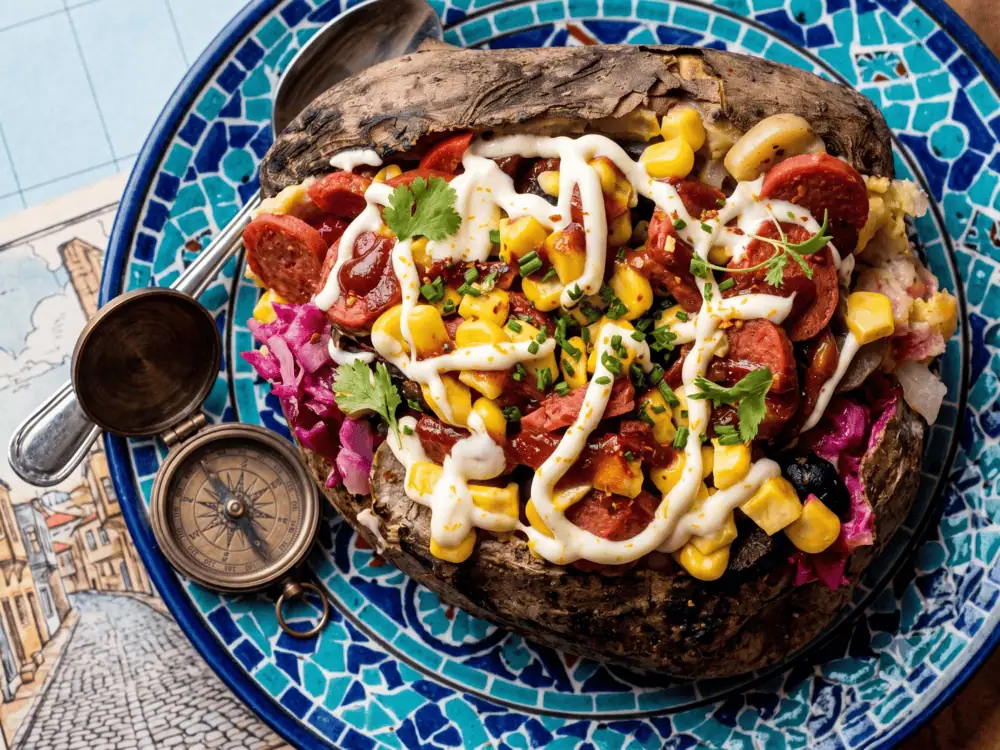
That base matters more than people realize. It’s the reason kumpir isn’t just “a potato with stuff on it” — the butter-and-cheese mash is what makes every topping you pile on afterward taste like it belongs there instead of just sitting on top getting cold.
Only after that mashing step do the toppings come in. And that’s where the real decision-making — and the real risk of overdoing it — begins.
The Ortaköy Kumpir Ritual: How Ordering Actually Works
If you’ve never done this before, the process can feel chaotic. Vendors are calling out, potatoes are coming out of ovens, and there’s a wall of toppings in front of you daring you to pick. Here’s the actual sequence, step by step.
Step 1: Pick Your Stand
Ortaköy’s kumpir vendors line up almost shoulder to shoulder along the waterfront strip near the mosque, and honestly, most of them are more similar than different — same base potato, overlapping topping lists, similar prices. Don’t overthink this part. Look for the stand with the busiest, freshest-looking topping trays and the shortest line that isn’t empty (empty means slow turnover, which means the toppings have been sitting).
Step 2: Order the Potato, Not the Toppings
You start by simply telling the vendor how many kumpir you want — “iki kumpir, lütfen” (two kumpir, please) is all it takes. They’ll pull a potato from the oven, split it open on a paper tray, and start mashing in the butter and cheese while you wait. This part isn’t optional or customizable — everyone gets the same buttery, cheesy base.
Step 3: Approach the Topping Bar
Once your potato’s mashed, you (or the vendor, depending on the stand) move down the row of topping bowls. This is the part people get wrong. A typical stand offers somewhere between fifteen and thirty toppings — everything from corn and olives to Russian salad, sausage, and pickled vegetables. You are not expected to use all of them. Treat it more like a spice cabinet than a buffet: a few well-chosen toppings, not a landfill.
Step 4: The Sauce Decision
At the very end, you’ll be asked about sauces — usually ketchup and mayonnaise, sometimes a spicy sauce or garlic yogurt too. Most stands throw these in for free. This is the step where people either finish their kumpir well or ruin it by drowning an already rich, cheesy potato in more sauce than it needs.
Step 5: Find a Spot and Eat It Fast
Kumpir is best eaten hot, standing at a rail or perched on a low wall by the water. It cools fast once the toppings are mixed in, and the textures start to separate if you let it sit. Don’t linger too long taking photos before you dig in — that’s a rookie move that costs you the best five minutes of the eating experience.
The “Proper” Topping Combinations Locals Actually Order
Here’s the part that separates a good kumpir from a sad one: which toppings you actually pair together. The stands display a genuinely intimidating array — corn, peas, sausage, pickles, coleslaw, Russian salad, mushrooms, olives, and depending on the vendor, more unusual options like couscous or even seafood. But experienced eaters build in patterns, not chaos.
Stay connected during your trip
The Classic Build
This is the combination you’ll see most Istanbulites order without even thinking about it:
- Sweetcorn — for sweetness and texture against the creamy base
- Black olives — sliced, for salt and a briny bite
- Russian salad (a mayo-based potato-carrot-pea salad) — adds richness that actually complements rather than fights the potato
- Turkish sausage (sucuk or sosis) — usually diced and lightly sauced, for a savory anchor
- A light drizzle of ketchup and mayo — not a flood, just enough to bring it together
This build works because it hits sweet, salty, creamy, and savory without any single flavor overwhelming the others.
The Comfort Build
A slightly heavier, more traditional-Turkish-flavors version:
- Haydari (a thick strained yogurt with garlic and herbs) — non-negotiable for a lot of regulars
- Pickled cabbage or turşu (finely chopped mixed pickled vegetables) — cuts through the richness
- Mushrooms — sautéed, for umami depth
- Sliced hot dog sausage in tomato sauce — yes, the same style you’d see at Turkish breakfast, and it works here too
This combination leans more sour and tangy, which balances the fattiness of the butter-and-cheese base especially well.
The Mistake Build (What Not to Do)
The most common tourist mistake is treating the topping bar like a personal challenge — piling on eight, ten, twelve different toppings because “it’s included.” Two things happen when you do this:
- Flavors cancel each other out. Sweetcorn next to spicy sauce next to pickles next to Russian salad all fighting for attention just tastes muddy, not complex.
- Texture turns to soup. Too many wet toppings (Russian salad, pickles, sauces) break down the fluffy potato base into something closer to a lukewarm mash. It stops being satisfying to eat within about ten minutes.
The rule of thumb worth following: pick one creamy element, one crunchy/pickled element, one protein, and go easy on the sauce. Three or four well-chosen toppings beat ten random ones every time.
The Sweet Version (Yes, It Exists)
A handful of vendors also do a dessert-style kumpir — same base potato, but topped with Nutella, fruit, or other sweet fillings instead of the savory lineup. It’s a genuine option and not just a gimmick, but it’s a niche order. If you’re curious, ask before you commit — not every stand offers it, and you don’t want to discover that mid-order.
Common Mistakes First-Timers Make
Beyond overloading the toppings, a few other things trip people up:
- Skipping the queue check. Weekends bring serious crowds to Ortaköy, and lines at the busier stands can stretch a fair distance. If you’re short on time, go on a weekday or earlier in the day.
- Not asking about portion size. Kumpir potatoes are genuinely huge. One is easily enough for two people to share, especially if you’re also planning to eat elsewhere in Ortaköy that day.
- Assuming every stand is identical. They’re similar, but not the same — some are noticeably more generous with cheese and butter than others, and some let the potato oven-dry a bit if it’s not busy. If a stand looks dead quiet at a normally busy hour, that’s a signal to walk to the next one.
- Forgetting it’s a knife-and-fork situation at first. The potato arrives on a paper tray or in a cup-style container, mashed together — it’s not a hand-held street food in the same way a simit or a döner wrap is, at least not until you’ve mixed everything in and it firms up enough to eat with a fork while walking.
Honest Pricing: What Kumpir Actually Costs in 2026
This is where a lot of guides either quote outdated numbers or just guess. Here’s the honest picture: kumpir pricing in Ortaköy has climbed noticeably in the past couple of years, tracking Turkey’s broader inflation and the area’s popularity with both tourists and Istanbul locals crossing town for it. Recent pricing puts a well-loaded kumpir with a handful of toppings somewhere in the range of roughly 200–350 TL, though a very simple, lightly topped one can come in lower, and a stand near the busiest corner of the strip can run higher.
A few honest notes on pricing:
- Prices vary stand to stand, sometimes significantly, even along the same short stretch of waterfront. It pays to glance at a menu board before you commit if the number matters to you.
- The Turkish lira moves fast. Given how much exchange rates and local inflation shift, treat any specific number — including the range above — as a snapshot, not gospel. Check a current menu or delivery-app listing for the stand you’re at before ordering if you want precision.
- Extra toppings can add up. Some vendors bundle a set number of toppings into the base price and charge per item beyond that; others let you pile on freely for one flat price. Ask before you load up if cost matters.
- It’s still considered a budget-friendly, filling meal relative to a sit-down restaurant lunch on the Bosphorus — the value is in how much food you get for the price, even with recent increases.

Where to Go: Reading the Stand Row
Ortaköy’s kumpir vendors sit in a tight row facing the water, close to the mosque and the market square. A few practical notes for picking among them:
- Look for turnover, not just size of the display. A stand constantly serving customers has fresher toppings than one that’s been sitting untouched.
- 24-hour stands exist. Some vendors run around the clock, which is genuinely useful if you’re wandering Ortaköy late at night after dinner elsewhere or catching the view of the illuminated Bosphorus Bridge.
- Seating is casual and limited. Most people eat standing at a rail, on a low wall, or on the steps near the water. Don’t expect table service or much comfort — it’s part of the charm, not a flaw, but pack that expectation in before you order.
Best Time to Go
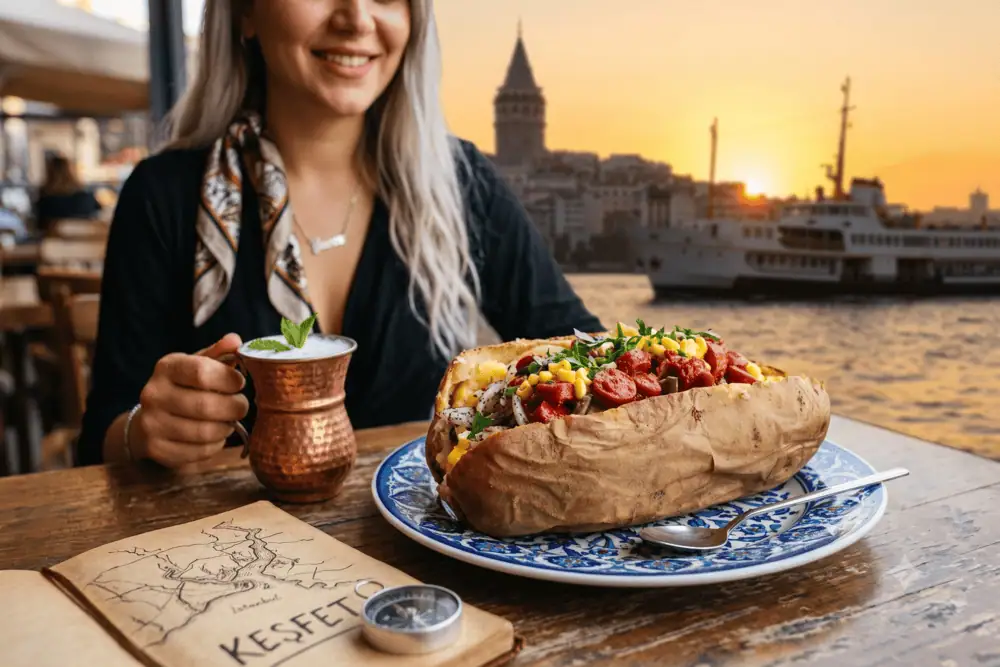
Weekday afternoons are noticeably calmer than weekends, when the Ortaköy square also fills with the neighborhood’s well-known arts-and-crafts market and pulls in a much bigger crowd. If you want the classic “kumpir with a bridge view, minus the elbow-to-elbow crowd” experience, aim for a weekday, mid-afternoon, before the evening rush and before the weekend market takes over the square.
Final Thoughts
Kumpir isn’t complicated food, but there’s a real skill to ordering it well — and that’s exactly what makes it worth understanding before you go rather than winging it at the counter. Start with the buttery, cheesy base, choose three or four toppings that actually complement rather than compete with each other, go light on the sauce, and eat it while it’s hot. Do that, and you’ll understand why Istanbulites still make the trip to Ortaköy for a baked potato, of all things — and why it’s earned its place as one of the city’s genuine street food icons rather than just a tourist photo op.