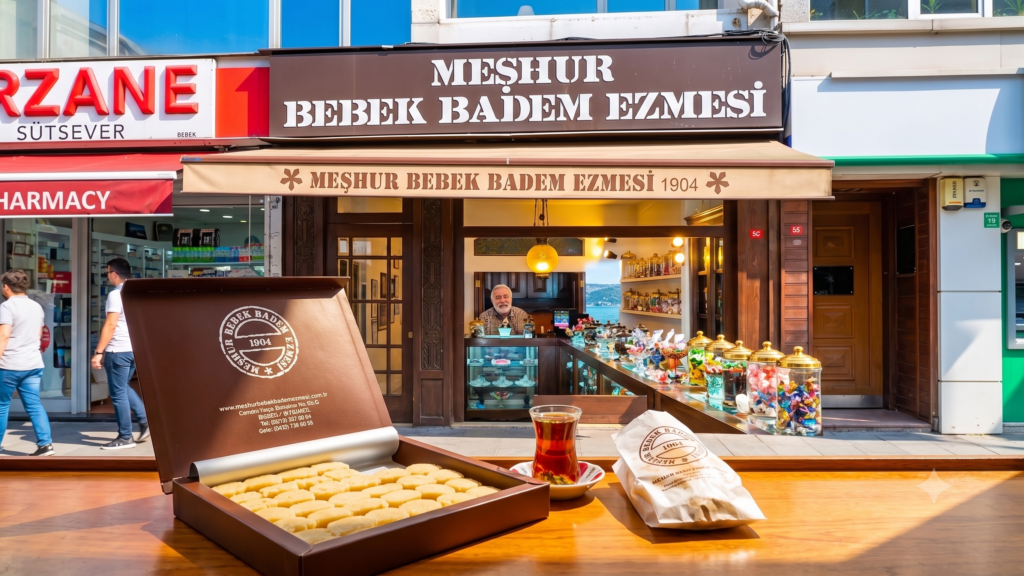
If you walk down Bebek’s narrow high street toward the water, you’ll probably miss it if you’re not looking. There’s no flashy signage, no queue snaking out the door, no Instagram-bait neon sign. Just a small, unassuming storefront that’s been selling almond paste to the same neighborhood — and increasingly, to visitors from all over the world — for well over a century.
That’s Meşhur Bebek Badem Ezmesi, and it’s not an exaggeration to call it the most famous marzipan shop in Istanbul. What makes it worth your time isn’t just the sweet itself (though that’s reason enough). It’s the fact that you’re buying into a family story that predates the Turkish Republic, made with a method that hasn’t fundamentally changed in generations.
Explore our guide on: Istanbul for Foodies: Markets, Tours & Itineraries.
Here’s what you actually need to know before you go — the history, what you’re tasting, what it costs, and the small mistakes that trip up first-time visitors.
A Love Story That Became a Century-Old Shop
The origin story of this shop reads more like a short novel than a business history, and that’s part of why it’s stuck around in local memory for so long.
Choose best excursion in Istanbul
The shop’s registered founding date is 1904, though the actual history stretches back further — the original shop was first founded in Mudanya, across the Sea of Marmara, by the grandfather of Sevim İşgüder, who still runs the shop today. The exact founding date of that original shop is unknown because a fire destroyed the records.
From Mudanya to Bebek
Mehmet Halil Bey, originally from Mudanya in Bursa province, came to Istanbul to study. His father back home was a candymaker, and it was with his father’s help that the family set up Meşhur Bebek Badem Ezmesi in Istanbul in 1904, selling marzipan, almond cookies (acıbadem kurabiyesi), and hard candy (akide şekeri).
The plot twist is the romance. While studying in Istanbul, Mehmet Halil met Anastasya, an Istanbul Greek woman from Arnavutköy. Their families objected to the relationship at first — a Turkish man and a Greek woman marrying wasn’t a simple matter at the time — but the families eventually came around. After the marriage, the grandfather rented a shack in Bebek to use as a shop, on the exact plot where the ferry port stands today. Father and son worked there together, making hard candies, marzipan, macaroons, and buzlama.
Four Generations, One Family
The shop’s survival wasn’t guaranteed. Mehmet Halil Bey and Anastasya had four children — two boys, two girls. When Mehmet Halil died, his eldest daughter Sema was 14 and his younger daughter Sevim was only two. Anastasya took over the business herself, preparing marzipan, cookies, and Easter cakes with her children’s help. Her two sons died young, and it was the daughters who grew up helping run the shop for twenty years before Anastasya became ill.
Sevim İşgüder — who, as an infant, was essentially raised inside this shop — eventually took the reins herself and has been the name most associated with the business for decades. Today the shop is run by the fifth generation of the same family.
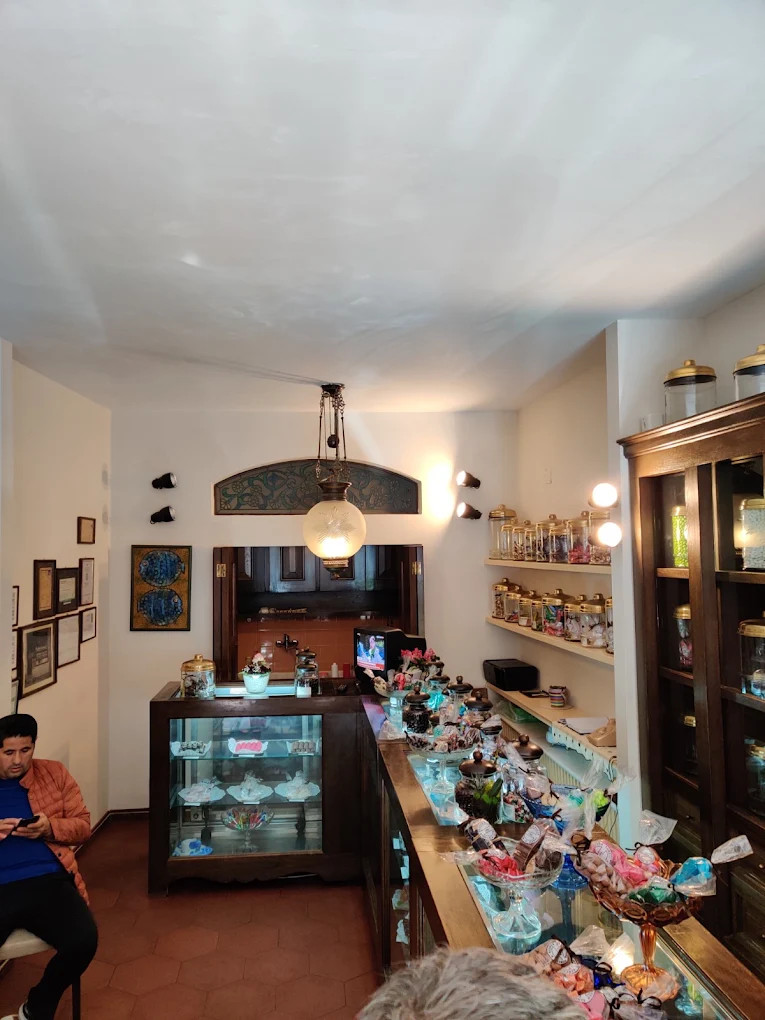
What strikes most visitors once they hear the backstory is how physically unchanged the place feels. The historic shop has reportedly used the same furniture since 1974 — so when you step inside, you’re not looking at a “heritage-styled” renovation. You’re looking at the actual fixtures a previous generation used.
What You’re Actually Tasting
Stay connected during your trip
Marzipan gets a bad reputation in a lot of countries because mass-produced versions lean hard on almond extract and not much real almond. That’s not what’s happening here.
How It’s Made
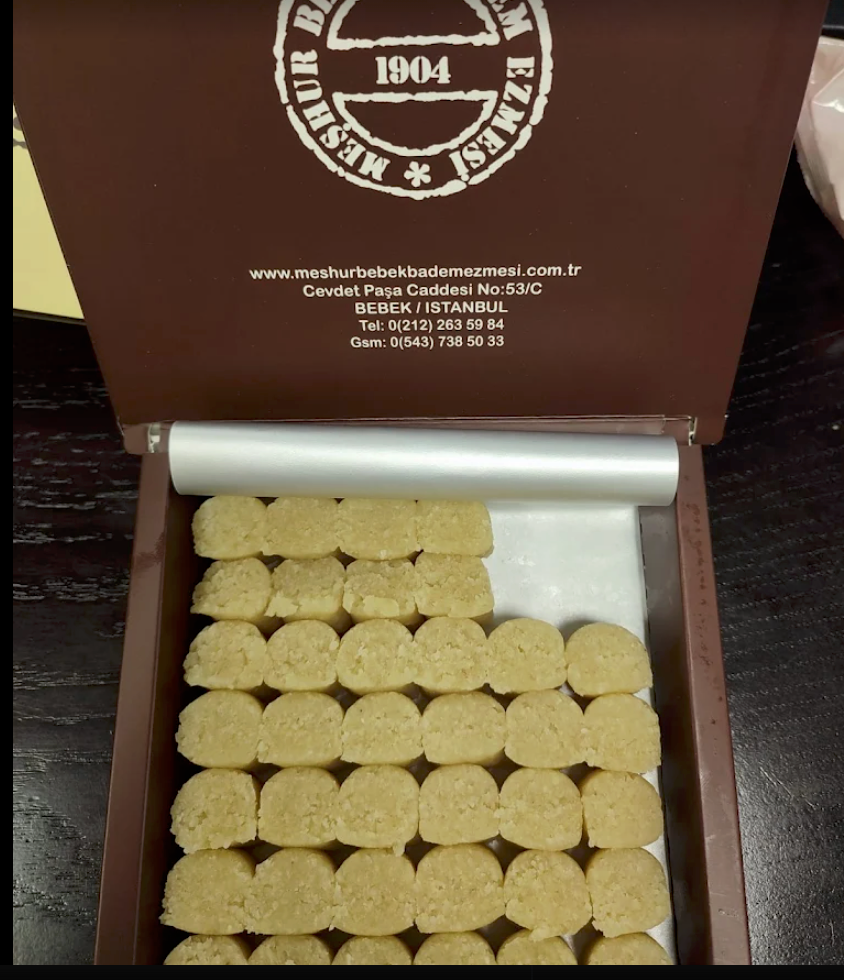
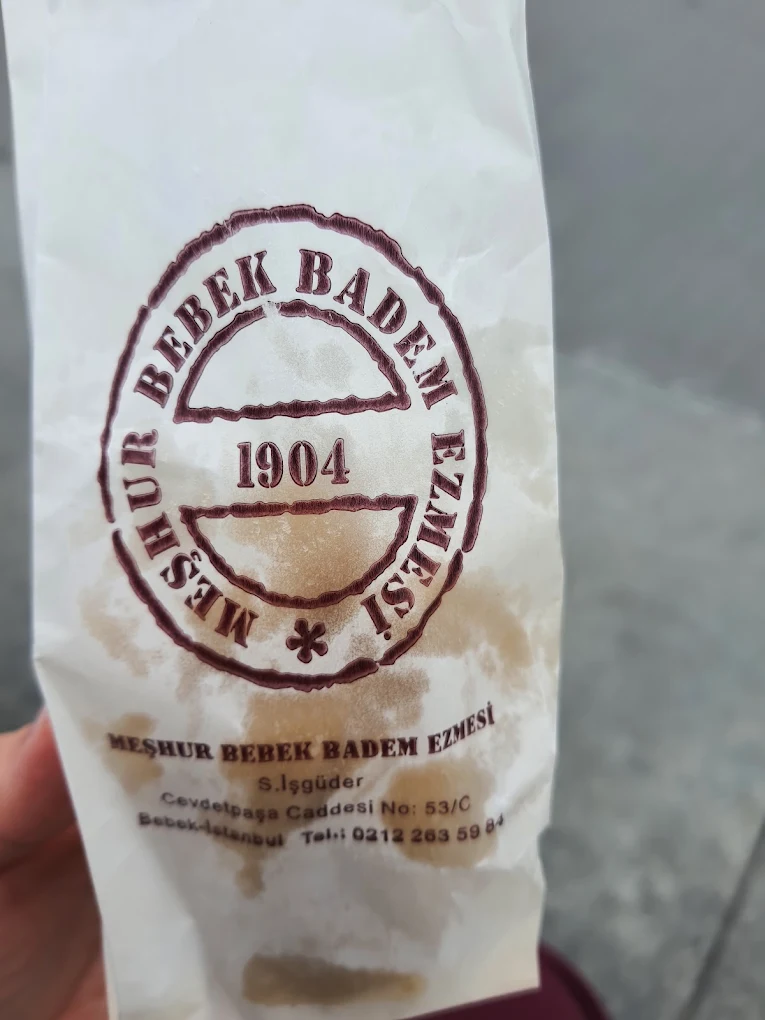
The almonds are sourced from different regions, then cleaned, dried, and ground into a fine powder before being mixed with water to form a dough. That dough is then pounded by hand in a mortar to reach the right texture. It’s slow, physical, unglamorous work — and it’s precisely why the product has held its reputation for so long. There’s no shortcut version of this being sold at the same address.
A few things worth knowing before you taste it:
- It’s genuinely handmade, not machine-extruded, which means pieces aren’t perfectly uniform in shape or size — that’s a feature, not a flaw.
- It’s made fresh and without preservatives or additives, which also means it has a short shelf life — don’t buy it thinking it’ll last in your suitcase for a month.
- It comes in three size options — half a kilo, 750 grams, and a full kilo — so plan your purchase around how many people you’re bringing it home for.
Plain vs. Pistachio
This is the one decision you’ll actually have to make in the shop. Alongside the classic almond marzipan, there’s a pistachio version that’s just as beloved by regulars. Locals often recommend picking up a full box of the classic and asking for a row of pistachio paste on the side, since it’s delicious but frequently overlooked by first-time visitors who don’t know to ask for it.
If you genuinely can’t decide, don’t stress over it — nearly every long-time customer’s advice online converges on the same tip: buy a mixed box. It solves the indecision and gives you something for people who claim (wrongly, in most locals’ opinion) that they don’t like marzipan.
Visiting the Shop: What to Expect
Finding the Storefront
The shop sits at Bebek Mahallesi, Cevdet Paşa Caddesi No: 53/C, in the Beşiktaş district, right along Bebek’s main pedestrian strip, close to the waterfront. It sits at the lower end of Bebek’s narrow high street, which means if you’re doing a Bosphorus-side walk through the village, you’ll pass right by it without needing to detour.
The shop operates daily from 09:00 to 21:00, and if you can’t make it in person, orders can be arranged through their Instagram page or WhatsApp line — useful if you want to pre-order a large box for a dinner party or gift before you show up.
Inside
Don’t expect a café-style seating area or a curated retail experience. It’s not really set up as a restaurant, though there are typically a table or two where you can sit and taste the sweets with coffee or tea. Step inside and the atmosphere itself tells you how much history is packed into this small space — it’s quiet and calm, usually with staff going about their work and, often, a shop cat sleeping somewhere nearby.
That low-key, unbothered atmosphere is genuinely part of the appeal. This isn’t a shop performing “authenticity” for tourists — it’s a working neighborhood confectionery that happens to have become internationally known.
Pricing Reality: What to Expect to Pay
Here’s where honesty matters more than hype. Turkey’s currency has moved a lot in recent years, and food and confectionery prices — especially handmade, additive-free products using imported and specialty almonds — track that inflation closely.
As of the most recent pricing data available, the shop’s marzipan ran around 350 TL per kilogram for the plain version, and roughly 395 TL per kilogram for the mixed pistachio version. At an exchange rate near 47 TRY to 1 USD, that put a kilo in the range of $7–8 — genuinely inexpensive for a handmade, artisanal product of this quality.
But treat those numbers as a starting reference point, not gospel. Prices in Turkey have historically moved upward fast, and by the time you visit, expect the actual number at the register to be noticeably higher. A few honest notes on cost:
- It’s not the cheapest marzipan in the city — reviewers consistently describe it as being on the more expensive side compared to an average marzipan or Turkish delight shop, and locals generally agree the quality justifies it.
- Smaller portions exist. Boxes as small as 350 grams are available if you don’t want to commit to a full kilo, which is a smart move if you’re traveling and worried about shelf life.
- Confirm the current price before you commit to a large order, especially if you’re buying multiple kilos for gifts — a quick WhatsApp message ahead of your visit can save you a surprise.
Mistakes First-Timers Make
A few small missteps come up again and again in visitor accounts, and they’re easy to avoid once you know about them:
- Buying too much, too early in the trip. Because it’s additive-free and fresh, it doesn’t travel well over multiple weeks. If you’re buying as a souvenir, do it near the end of your stay, not the beginning.
- Skipping the pistachio option entirely. Plenty of visitors walk in, grab the classic almond version, and leave without knowing a pistachio version exists — and it’s often described as delicious and underrated compared to the classic.
- Expecting a big retail experience. This is a tiny, old-fashioned shop, not a flagship confectionery store. If you’re expecting extensive packaging options, gift-wrapping services, or a large seating area, adjust expectations accordingly.
- Assuming it’s a quick weekday errand only. Since it’s open daily, including weekends, it fits naturally into a longer Bebek waterfront stroll rather than requiring a dedicated special trip.
Why It Belongs on Your Bebek Walk
If you’re exploring Bebek as part of a wider Bosphorus villages route — pairing it with Arnavutköy’s colorful wooden houses or a coffee stop in Bebek Park overlooking the water — this shop is a natural, low-effort addition rather than a detour. It sits directly on the neighborhood’s main walking street, takes only a few minutes to pop into, and gives you something tangible and edible to carry forward from a neighborhood that’s otherwise mostly about views and architecture.
It’s also a good contrast to Bebek’s reputation as one of Istanbul’s more polished, upscale corners. This shop hasn’t been reinvented to match that image — it’s kept its quiet, unhurried, old-shop character even as the neighborhood around it has become one of the city’s most fashionable addresses.
Conclusion
Meşhur Bebek Badem Ezmesi isn’t trying to be an attraction — it’s a family business that happened to become one, simply by doing the same thing well for five generations. The love story behind its founding, the fact that its furniture has barely changed since the 1970s, and the fact that it’s still hand-pounding almond paste the same way it has for over a century all add up to something you rarely find on a modern city break: a genuinely unbroken thread of local history you can actually taste. Go for the marzipan, but stay curious about the story — it’s the kind of small, quiet detail that makes Bebek feel less like a stop on an itinerary and more like a real neighborhood.